Back in March I started work on this project, funded by Heterodox Academy. At the start this was a loosely defined, exploratory engagement project with 3 main tasks: some one-to-one interviews (in April-May), some seminars to discuss issues and options (in May) and a discussion paper (in June).
The paper would aim to map and make sense of viewpoint diversity issues in Australian higher learning contexts where controversial topics seem less open to scholarly debate than they could be. And suggest ways to promote greater viewpoint visibility on our campuses. The principle here is that intellectual pluralism should be accepted (and protected) as an inescapable feature of the practice of rigorous and open-minded scholarly inquiry in universities.

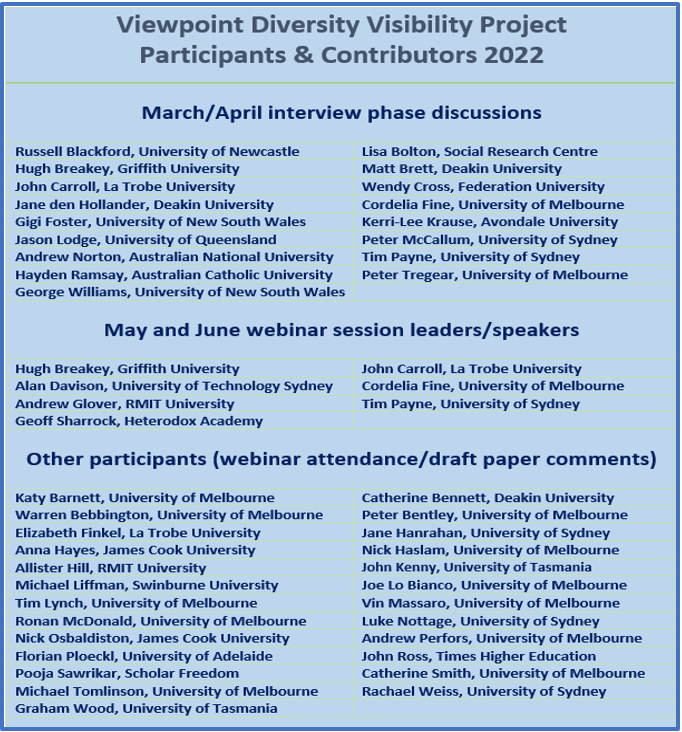
Time constraints made the project quite challenging. Under the HxA funding agreement, the firm deadline for task completion was mid-July. In the event, while some parts of the process were quite stressful, there were few insurmountable setbacks, and only minor delays. After contacting many people across the Australian university sector in March and April, I had good support from some colleagues (old and new); good engagement from some senior people willing to make time to share views; generous support from those willing to speak (and listen) at the May and June webinars; and some wider engagement since then, from those willing to read and comment on the (very long and wide-ranging) July working paper.
In Times Higher Education John Ross reported on the June webinar discussion. Since then, I’ve shared the working paper widely, but with at times very limited response from some university groups, particularly at senior levels.
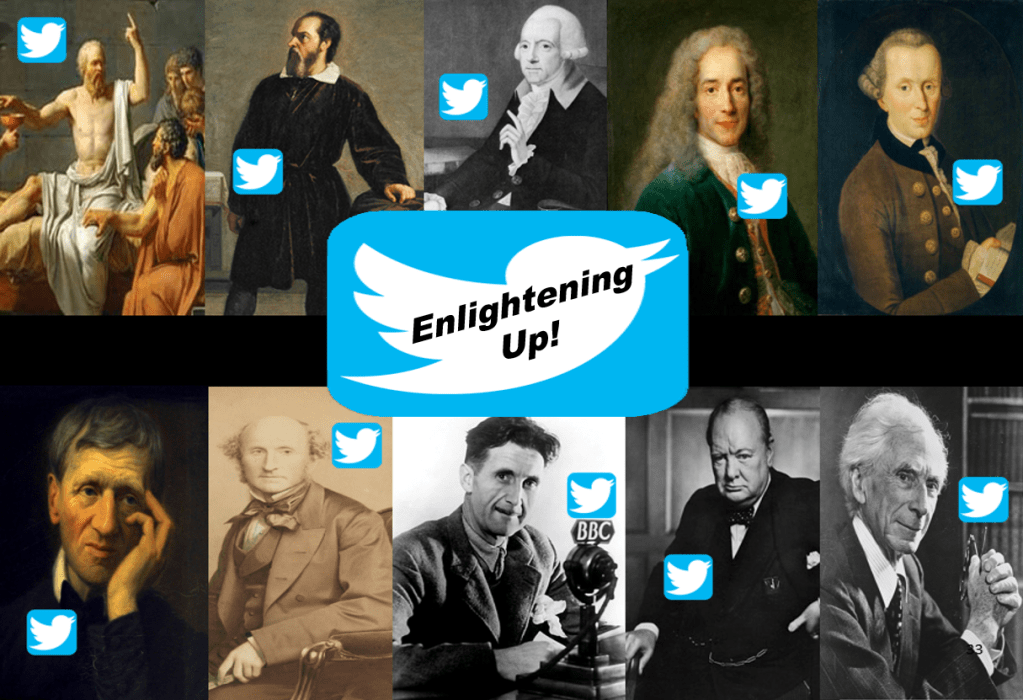
One part of the working paper that has attracted a good deal of front-line scholar interest is Chart 11 (some rules of engagement for class discussion, or Six ideas for enlightening up). I’ve updated these several times since first posting, in response to suggestions which (adopted or not) have been always constructive. In a separate post (or further Conversation commentary on these themes, if feasible) I’ll discuss some of the issues readers raised. These I think must arise with any attempt to design rules of engagement for scholars to use as a common approach across diverse fields of study, with diverse groups of students, on campus and online.
To summarise progress to date: as the working paper illustrates, many issues here are multi-faceted and intertwined. Their complexity goes well beyond the left-right labels and culture-war narratives that have politicised and polarised so many current debates. They could easily make the normative preconditions for higher learning in Australia very difficult to sustain. And they won’t go away anytime soon. They are embedded in wider public discourse disorders, well beyond the control of universities.
In times like ours, as social media dynamics amplify divisions, intolerance and antagonism instead of rational dialogue and shared problem-solving, a core task for universities still must be to seek and share and strengthen understanding, truth and knowledge reliably in ways that help build and mobilise advanced skills and expertise. In a modern democracy such as Australia, these are the “higher learning” projects we rely on to promote social stability, technological progress and “good” (just, sustainable) societies.
My sincere thanks to all those who took time to engage with a project that, inevitably, touches on many areas of potential controversy within and beyond universities. My next step will be to reflect and write further on these issues; on reactions to the project over the past few months; and on how higher learning institutions can continue their essential work in the cause of enlightening up.
© Geoff Sharrock 2022 (Contact geoffk.sharrock@gmail.com)
Notes
My paper’s argument represents the author’s own views. Readers should not assume that the contributors listed above – who were approached to seek a range of perspectives – all subscribe to all (or any) of the author’s views. Nor should anyone assume that Heterodox Academy necessarily endorses these.
Post-project process update
As noted, this project entailed a lot of work within tight timelines. In the event the most stressful aspect was lack of local management support. As I told those attending the first (May) webinar, I’d been running the project on an understanding (from the Dean) that my honorary fellow role at the University of Melbourne’s Graduate School of Education would continue over 2022.
But in the days leading up to that first webinar, an email from the Director of the Centre for the Study of Higher Education, Professor Sophie Arkoudis, informed me that (on her advice) MGSE had decided not to renew my (unpaid) role with MGSE after all. Her brief note (by email) offered no explanation for the reversal. Nor did it invite any discussion.
This was a surprise. Not least because back in March (in response to my note to the Dean, Professor Jim Watterston), Sophie had emailed to congratulate me for receiving funding for the project; and to ask for details so that she could suggest who within MGSE I could invite to participate. In response, I outlined it as follows:
…The project aim is broad: how to make viewpoint diversity more visible on campus, and how to promote free inquiry and open exchange as core values and community norms in HE contexts. My main tasks will be some interviews, some workshops and preparing a discussion paper. I’m interested in learning about this at two general levels. First, policy/admin settings from a leadership perspective – for example institution-level responses to the French Review and model code, and School-level briefings or modules on this to show staff and/or students how the updated policies apply in practice. Second, toolkits and/or good practices in the teaching and learning area – how staff promote open discussion among students, and help them deal with difficult topics, or controversies that come up from time to time. At either level, I’m interested in the ideas of those who’ve worked on these things – whether their ideas have been realised in policy or practice, or not. And of course, any cases that illustrate challenges or promising approaches…
delivered from Melbourne, May 2022
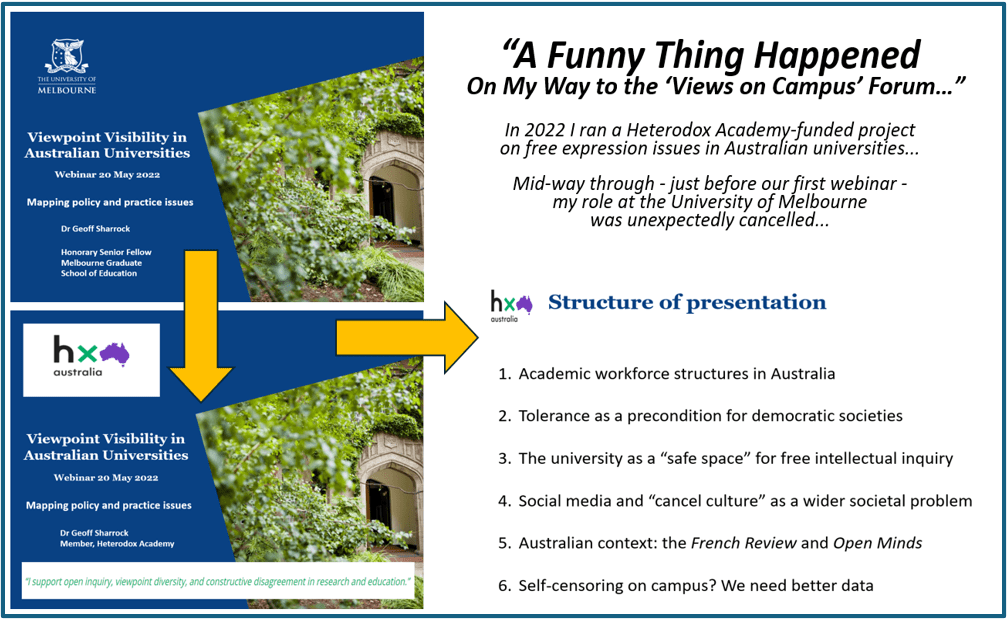
By May I had a lot of material to share on the substantive project, at the first webinar. And now, overnight, I had to quickly rebadge my slides to reflect the fact that I was no longer a member of the University. On the day, before commencing my first presentation, I updated those attending this way:
These last few weeks I’ve been working up today’s presentation while interviewing people across the sector. There’s a lot to unpack from the interviews and I won’t cover it all here. But before I start, I need to share some personal news which in the context of what I’m about to present will seem ironic. After working as a staff member here since 2008 and then since 2017 as an Honorary Fellow, I’ve just been cancelled. As of two days ago I’m no longer a Fellow with the University. My term was due to expire and about five weeks ago, a note from the Dean informed me that yes, they’d renew it for another year. But then just last week I had another note from the Director of the Melbourne Centre for the Study of Higher Education (where I used to work), which reversed that advice. So, over the past week, my main concern has been not to derail this project…
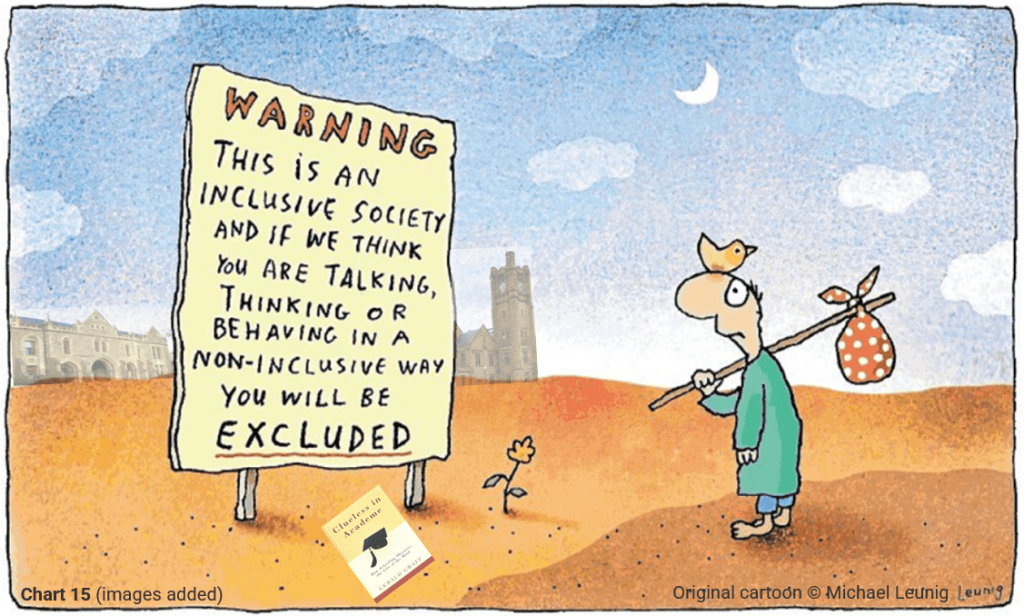
Project participants must have been surprised – and must have wondered what the reasons might be. While I had no further information to offer, to some this School of Education “leadership” decision seemed Kafkaesque. I could only speculate that it might be an example of the Karl Popper tolerance paradox I would later discuss in the HxA project working paper (Chart 15).
I continued with the project, then in June I forwarded a progress report to the Dean (cc’d to the Vice-Chancellor, Duncan Maskell) and called for a review of the May decision – but without getting any direct management response at all. Perplexed at the wall of silence around the unexplained decision, in July I forwarded a project update to the VC, the Dean and a CSHE colleague who had participated in the project:
Further to my note in June (below), the attached paper (21 July version) is a long read (9200 words plus charts). It’s a working draft currently receiving comments; and it is likely to be updated further at my blog in the coming weeks … Briefly, the paper maps current viewpoint diversity debates and challenges for policy and practice in Australian universities. It quotes commentary from a number of university vice-chancellors to illustrate issues. And it should be on the radar of senior people and/or their advisers.
These topics are situated in wider literature on the traditional role of the university as a safe space for free inquiry in liberal societies, in the Western enlightenment tradition. Drawing on thinkers such as Voltaire, Kant, Mill, Popper and Russell, the paper highlights the importance of promoting tolerance as a core value in modern multicultural societies where public discourse is now being reshaped, in part, by new social media dynamics. It highlights the potential for scholarly work to enable diverse but connected communities, often with conflicting doctrines, to co-exist and find common ground. As well, it reflects on the politics of recent Australian policy debates (the French Review) and campus controversies (the Peter Ridd case). The paper draws insights from media commentary on these topics; from recent interviews and webinars with people who work in the Australian sector (around 40 so far); and from studies on issues such as cancel culture and self-censoring on campus in the US and UK contexts. Some examples of conceptual and policy pitfalls are analysed. With the aim of synthesising several strands related to this topic, the paper highlights the often complex balancing act for institutions, as they seek to create classroom and campus conditions for open inquiry while upholding duties of care for student and staff well-being.
As a way forward it proposes a “radically inclusive” university which actively pursues an “enlighten up” public mission. And some practical tools are presented to illustrate how an “enlighten up” approach might work in classroom settings and other scholarly forums. Please feel free to share this note and the draft paper with colleagues; comments are welcome. (Jim, as per my June note, the offer to present a seminar or webinar on this topic – perhaps to students with an interest in higher education policy – stands.)
Again, there was no management response. In September I forwarded a further update to the Dean and the VC and called yet again for a review of the May decision. Then weeks later (having had no reply) I sent them a follow-up note with some other University colleagues copied in. This time (recalling a line from Orwell) I suggested that the May management decision was Kafkaesque, and that those responsible should read my work and enlighten up*.
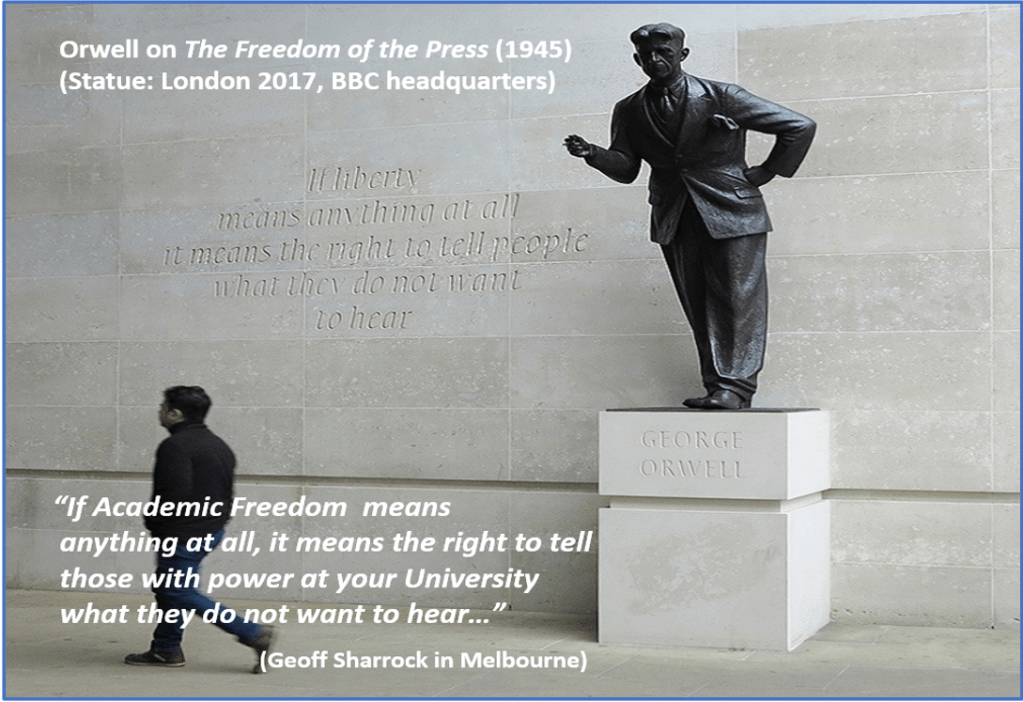
When this too drew no management response, a small group of professors (and a CSHE honorary fellow with expertise in university governance) signed a letter of support.
Letter to the Vice-Chancellor and the Dean, Melbourne Graduate School of Education
As University of Melbourne scholars, we write to express our support for Dr Sharrock in his work on open inquiry and constructive disagreement in Australian universities; and in his request to be re-appointed as an Honorary Senior Fellow at the University. Dr Sharrock has a long association with this University. He has:
- worked with former Vice-Chancellor Glyn Davis on the University’s Growing Esteem strategy;
- published scholarly work on university leadership and higher education policy and management with the Centre for the Study of Higher Education and LH Martin Institute (the Centre);
- taught and supervised postgraduates in his field with the Centre;
- engaged in expert commentary with The Conversation and other media outlets on higher education policy; and
- conducted an independent and confidential internal review of the University’s Business Improvement Program restructure.
We share Dr Sharrock’s concern that, shortly after he commenced work on an externally funded project in 2022, the Melbourne Graduate School of Education undertook in April to extend his honorary appointment for a further year, but then reversed its decision in May without explanation or discussion. The reversal took place mid-project, when it was known that Dr Sharrock was relying on University systems to conduct recorded interviews, host recorded webinars and transcribe material to complete the project on time, as per his funding agreement with Heterodox Academy.
When Dr Sharrock appealed to MGSE to reconsider its decision in June, there was again no explanation or discussion. Instead, an email from HR advised that he was about to be cut off from the University’s IT systems. Whatever the concerns were that led MGSE to reverse its initial decision mid-project, by its refusal to explain or discuss the matter, MGSE has allowed no opportunity for these to be addressed by a long-standing member of this University. Those of us who have participated directly in the project, and/or have read the discussion paper, believe that the issues it examines are complex and relevant to the work of universities. We believe the conduct of the project itself has been transparent, constructive and scholarly, with its aim of improving dialogue across viewpoints on these matters. The administrative treatment of Dr Sharrock’s affiliation with the University does not seem consistent with the spirit of such a project. Nor does it reflect the procedural fairness that should apply in such cases, whatever decision is reached.
As the weeks went by, this too drew no response from MGSE management. Fortunately, some colleagues in another School at the University proposed an honorary role with their group. With luck, this new affiliation with the University of Melbourne will support my future work in this area of leadership, policy and management in Australian higher education.
*UniMelb’s Academic Freedom of Expression policy has application here:
…all scholars at the University are free to engage in critical enquiry, scholarly endeavour and public discourse without fear or favour … the University supports the right of all scholars at the University to search for truth, and to hold and express diverse opinions. It recognises that scholarly debate should be robust and uninhibited. It recognises also that scholars are entitled to express their ideas and opinions even when doing so may cause offence. These principles apply to all activities in which scholars express their views both inside and outside the University. The liberty to speak freely extends to … criticism of the University and its actions. Scholars at the University should expect to be able to exercise academic freedom of expression and not be disadvantaged or subjected to less favourable treatment by the University for doing so…
 Big Little Thought Crimes in Melbourne