Recent moves by university leaders to restrict campus protests and “combat racism” recall past debates on the uses and limits of free expression in Australian higher education. How do institutions meet campus safety and inclusion commitments without undermining the main aims of higher learning institutions – to seek, share and strengthen knowledge and understanding, as reliably as they can?
Recently, Universities Australia chair Carolyn Evans – a vice-chancellor with scholarly expertise on this topic – reflected on the “incompatible” demands universities may face:
“We have clear legal requirements around academic freedom and freedom of speech that are enforceable by TEQSA and … obligations with respect to psychological safety and safety of students, which are also legislated and are also a high priority … I think there might be an important piece of work to be done, not just by us, but by governments, thinking about the way in which those get prioritised because at the moment we’re being asked to do sometimes incompatible things.”
Another Australian vice-chancellor with expertise in this area, George Williams, raises similar concerns. A university “has got to be a place where we avoid groupthink and people feel free to explore and express ideas”. But then, “with hate speech and other things, we need to clamp down and draw lines“. But then, “free speech” in Australian law is “not protected in any general and meaningful way”. So, for university administrations “This is a very contested area, very hard to navigate, because free speech itself … you can’t define it … when it becomes politicised … there’s so many grey areas…”
To unpack the dilemmas for institutions and leaders here, let’s recap. The 2019 French Review affirmed academic freedom as a “defining value” for universities; one that could “be traced back to Socrates’ defence in Plato’s Apology … of his right to discuss controversial topics”. But “freedom of lawful speech” didn’t extend to acts of intimidation, or serious disruption to teaching and research programs.
Factoring in societal limits on free speech, and statutory responsibilities for the safety and wellbeing of students and staff, Robert French showed how complex this balancing act could be. After wading through a plethora of existing policy statements (where he noted that terms such as “respect”, “harm” and “hate speech” could be defined too broadly and applied too restrictively), French likened his own task to “cleaning the Augean Stables”.
The Review’s key recommendation was a Model Code for universities to adopt or adapt. As a minimal set of “umbrella principles”, the Code still ran to several pages. It drew some clear but subtle distinctions, such as prohibiting expressive conduct that aims to “humiliate” or “intimidate”, but not speech that merely “offends”. The Code also spells out the statutory requirement that universities “foster the wellbeing of staff and students” as a set of duties which:
“includes the duty to ensure that no member of staff and no student suffers unfair disadvantage or unfair adverse discrimination on any basis recognised at law including race, gender, sexuality, religion and political belief; (and) includes the duty to ensure that no member of staff and no student is subject to threatening or intimidating behaviour by another person or persons on account of anything they have said or proposed to say in exercising their freedom of speech…”
So, the rules that universities must administer won’t ever fit neatly on a student T-shirt. Further, the Review warned that clearer rules alone would not suffice: “Far more important than rules will be a culture which embraces the inevitability of dissent on the one hand and the importance of compromise to the effective functioning of the institution.”
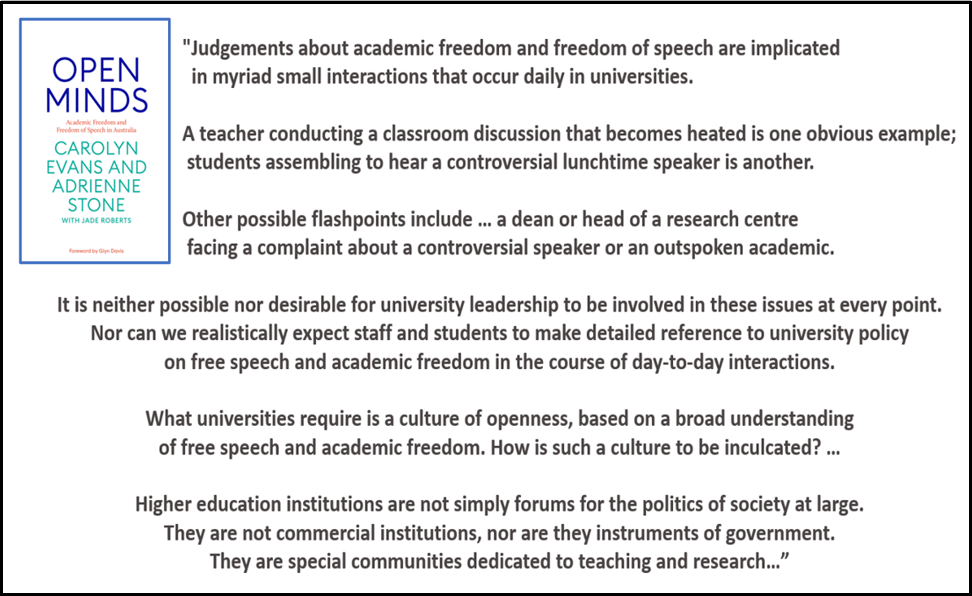
Reflecting on the Review in their 2021 book Open Minds, Carolyn Evans and Adrienne Stone judged it “unrealistic” to expect administrations to moderate directly the “myriad small interactions that occur daily in universities”. Or to expect students to “make detailed reference to university policy” to guide their own interactions. Echoing French in their view that universities need “a culture of openness, based on a broad understanding of free speech and academic freedom”, they asked: “How is such a culture to be inculcated?”
One way is to promote dialogue frameworks more systematically, as a professional skillset and an antidote to dogma and groupthink in class discussions and campus seminars. “Best practices” here include intellectual honesty, critical thinking and free and frank debate across viewpoints, underpinned by group norms of inclusive learning and collaborative problem-solving. My “model code” framework at Chart 1 aims to be short, sharp and simple enough for student groups to adopt as a practical set of “learning habits”. But also detailed enough to help guide complex and controversial debates on a wide range of issues – where topic awareness, term definitions, context assumptions and personal relevance may differ widely.
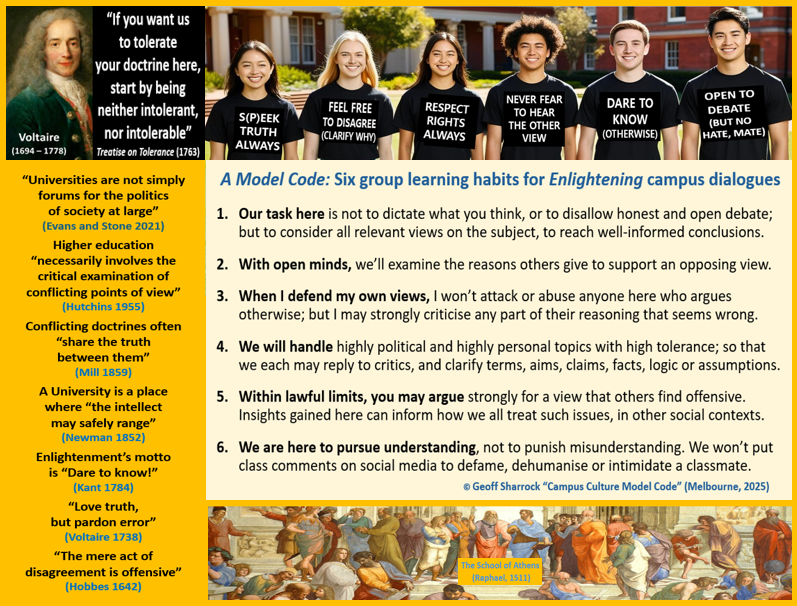
These “inclusive learning habits” broadly reflect the principles, formal policies and practical guidance Australian universities use to promote “respectful disagreement” as part of student learning and campus life. For example, the University of Melbourne’s online module for first-year undergraduates includes this guidance:
“Features of a respectful and constructive expression of a disagreement or opposing view are: – It is about the view, not about the person who expresses it – It opens up space for further discussion, rather than shutting it down – It refers to reasons for or against a view – It avoids sounding aggressive or judgemental – It invites further thought and input from others, giving the opportunity for collaborative learning.”
A premise of Chart 1 is that any point of disagreement on the topic at hand can be raised and made discussable. This presumes group norms of tolerance and civility toward those with opposing views. Not least when these seem seriously wrong-headed; or when individuals hold strong views for personal reasons.
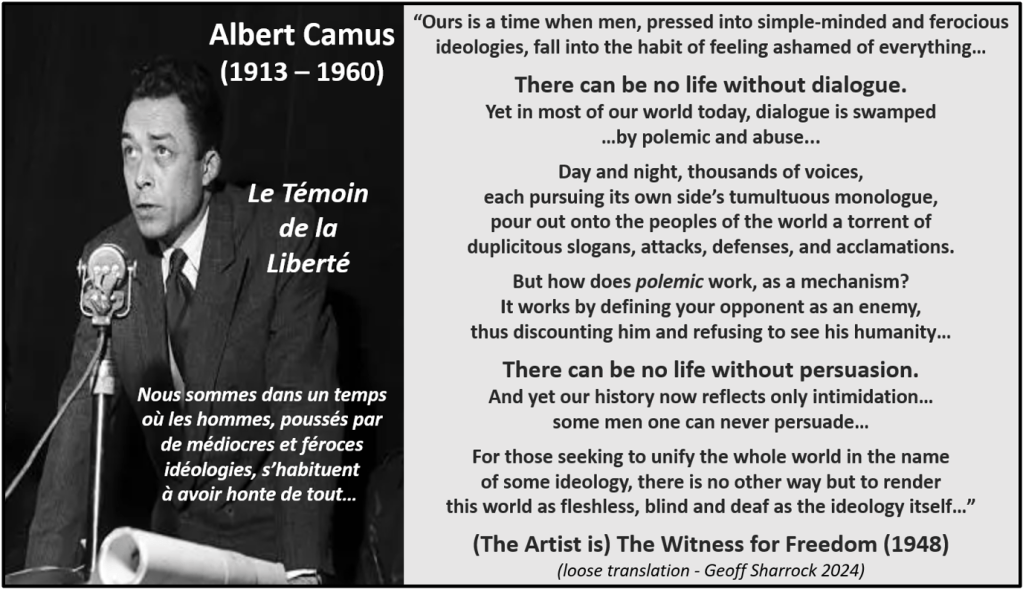
These group norms become even more salient when the topic is a “polarising” one that’s highly contested in wider public discourse. In many ways, today’s political climate – not least on social media – resembles the “polemic and abuse” that French-Algerian intellectual Albert Camus lamented in the Paris magazine Commentary, a few years after the Second World War (Chart 2).
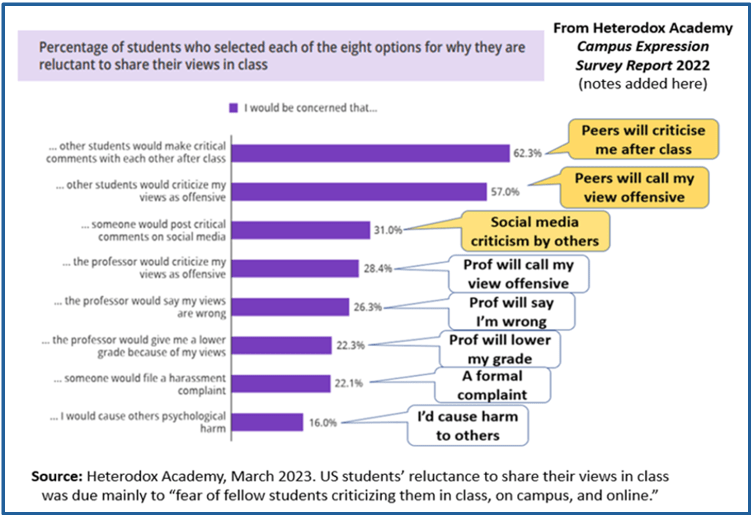
On today’s campuses, on many topics, student fear of peer disapproval looms large. A 2022 survey on campus expression by Heterodox Academy found that in US higher education, students’ reluctance to share their views in class was due mainly (but not only) to “fear of fellow students criticizing them in class, on campus, and online” (see Chart 16 in the Notes below).
Creating high-trust, low-risk forums to work through points of disagreement allows participants to practice the intellectual virtues of “charity” and “humility” that proponents of constructive disagreement often highlight, and to engage in collaborative problem-solving. So, the final point in Chart 1 calls for group members not to punish peers in online forums for a comment made in class. Instead (as Camus suggests), the task of dialogue is to persuade, not intimidate. Often this means letting classmates reflect and self-correct over time, as part of their own learning journey.
One challenge here is that neither tolerance nor civility are reflex human responses to disagreement. They are pragmatic, prudential social virtues that rely mainly on self-restraint to sustain a social order. As Oxford political theorist Teresa Bejan explains, the insight that expressing disagreement can cause distress, and often slides into distrust, contempt or abuse, isn’t new (Chart 3).
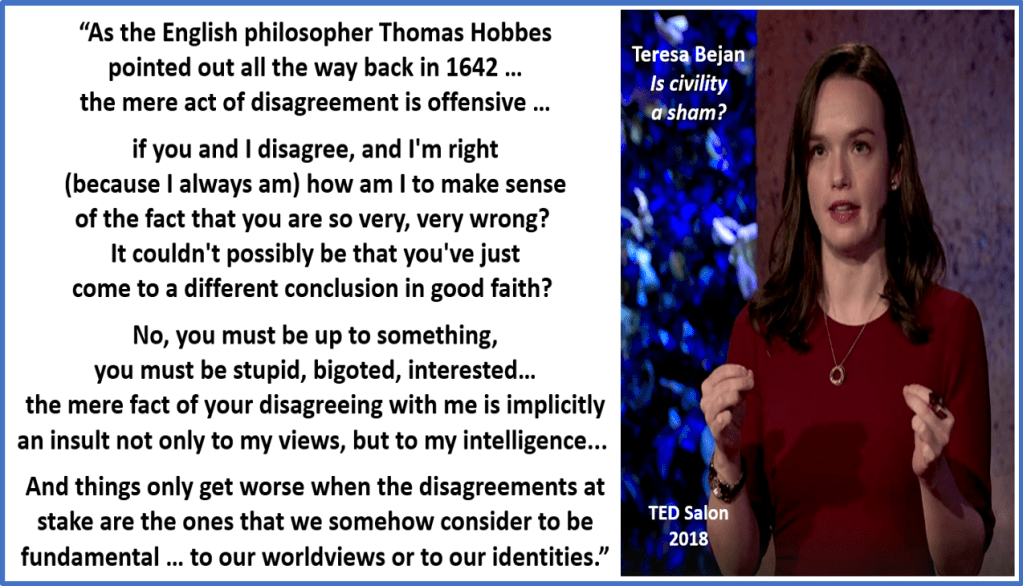
This helps to explain why it’s often hard to rally support for civility on contested topics. While essential to constructive dialogues that build common understandings, showing tolerance toward those on “the wrong side” may be misread and dismissed as agreement or complicity, rather than (say) diplomacy.
And there’s a case for diplomacy. In the “six habits” at Chart 1, item 4 lists some common factors that lead to the substantive point a student seeks to make being “lost in translation”. Particularly if views are not fully formed, the points of disagreement are not simple, and/or participants are attributing different meanings to the same key term. (As an aside, the University of Sydney’s new “civility rule” – which critics fear may be weaponised to restrict lawful free expression unduly – requires participants to define contested terms, such as some of the slogans used in recent campus protests.)
In practice, students who privately disagree with a classmate’s strongly held view (on any topic) may refrain from objecting when they judge that it’s not the time or place to tackle this issue with that person, for whom the stakes seem higher. In sum, students may self-censor not primarily from fear of peer disapproval, but from a sense of sympathy for a distressed classmate (see Chart 16). Or, as a matter of diplomacy, when a discussion turns into a shouting-match.
The University of Melbourne guidance noted earlier advises students to “pluck up the courage to speak”, “say what you think” and be “clear and not too wishy-washy”. This helps make viewpoints visible on the topic at hand. But as ever, there will be exceptions. On complex topics that are highly political, highly personal or hotly disputed in wider public discourse, “all the enlightenment we cannot see” may consist of judicious “self-censoring” responses in class debates. These may be modes of tolerance and civility that more assertive, less diplomatic class participants would dismiss as “50 shades of beige” on the part of complicit or morally compromised individuals.
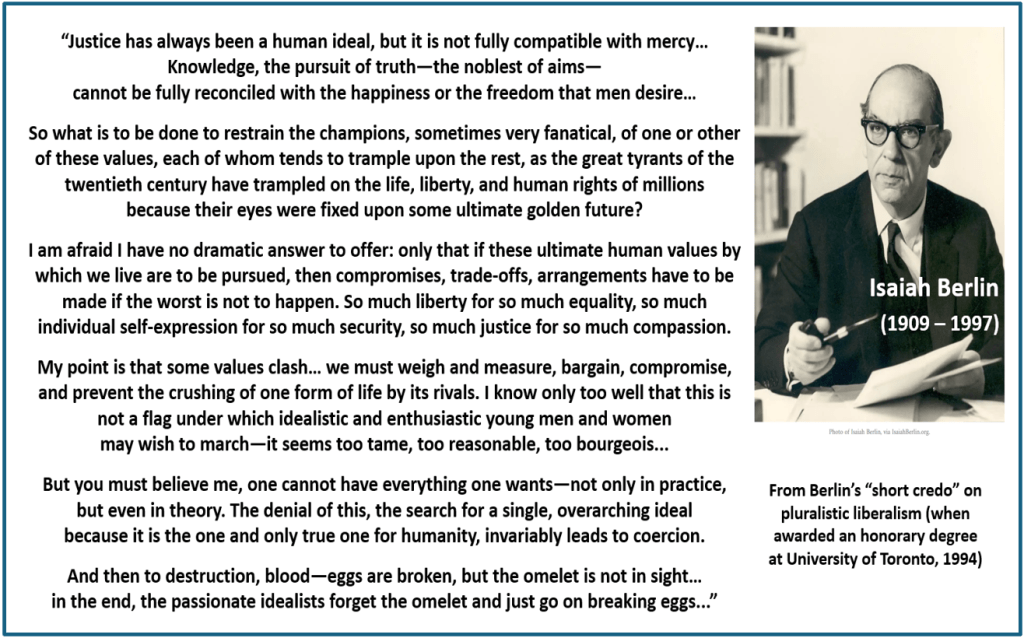
But in any sustainable social setting, “50 shades of compromise” seems inescapable. While tolerance is an “artificial” virtue (as Scottish philosopher David Hume suggests), it is an essential precondition for social cohesion and political progress in pluralistic democracies like Australia, where progress itself typically entails a better set of policy trade-offs than the alternative courses that other parties advocate.
The case for political compromise was well made in 1994 in Canada, by Russian/British philosopher/political theorist Isaiah Berlin (Chart 4). He lamented the crimes against humanity unleashed by various regimes in the 20th century in the name of some simple-minded idea of progress.
All that said, another premise of campus dialogues is that tolerance and civility don’t require respect for views that seem wrong-headed: as a general rule, proponents should expect (and learn to engage with) strong criticism of any significant flaw in the case they’re making (see Chart 10). After all, critical thinking and being able to engage others in solving complex problems are key skillsets for graduates, whatever their profession. But here we should note that the processes and dispositions that support “critical thinking” as a rational, open-minded and reflective “self-correcting” scholarly practice are not simple. The work of US scholar Peter Facione illustrates this (Chart 5).
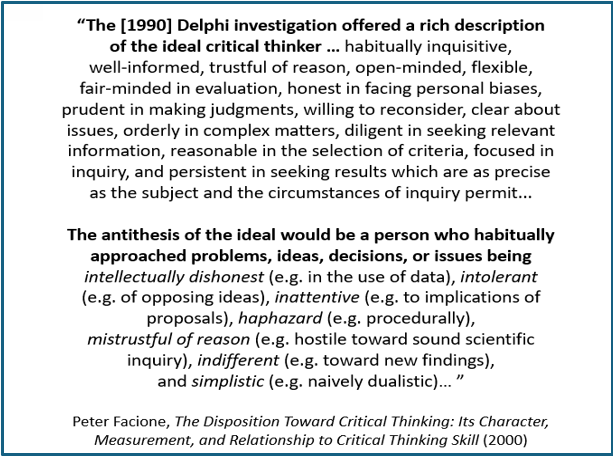
As Chart 5 suggests, dialectical scholarly debates often draw on different fields of study to make sense of complex sets of related issues. These may range very widely and pose serious translational challenges across disciplines and viewpoints.
As with formal campus rules, Facione’s guidance here isn’t student T-shirt material. But the implication is clear: any set of campus rules must allow scope to strongly reject other views, not “respect” them. We can reject a person’s view of an issue while respecting their “right” to express it. That said, a university’s commitment to “free expression” doesn’t extend to allowing serious disruption of a class or campus forum – for example by student activists. A predictable effect of this is to deny the rights of participants to talk, hear and learn about the topic the forum was set up to explore.
The first item in Chart 1 refers to this issue, as does the first sidebar quote by Evans and Stone. Chart 6 quotes from their book Open Minds, where they argue that “Universities are not simply forums for the politics of society at large … They are special communities dedicated to teaching and research”.
So, a related way to build campus cultures where “people feel free to explore and express ideas” is for universities to reassert their societal role as scholarly communities. The sidebar quotes at Chart 1 set disagreement-as-dialogue in a long tradition of thinkers about the value of free inquiry and open debate to societal progress; and the distinctive role universities can play in this. By design, these institutions should offer “safe” social spaces for scholars to seek insights, test ideas, devise innovations, design system reforms and make cases for change that support worthwhile causes.
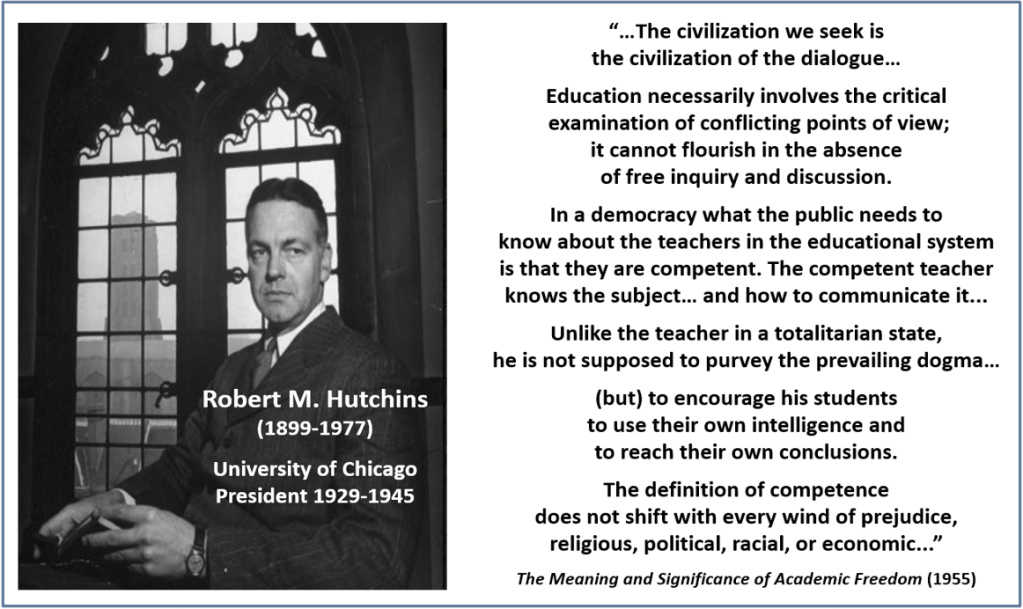
Chart 7 draws from a 1955 commentary on academic freedom by former University of Chicago president Robert Hutchins, which highlights that “conflicting points of view” are inescapable in this kind of higher learning setting.
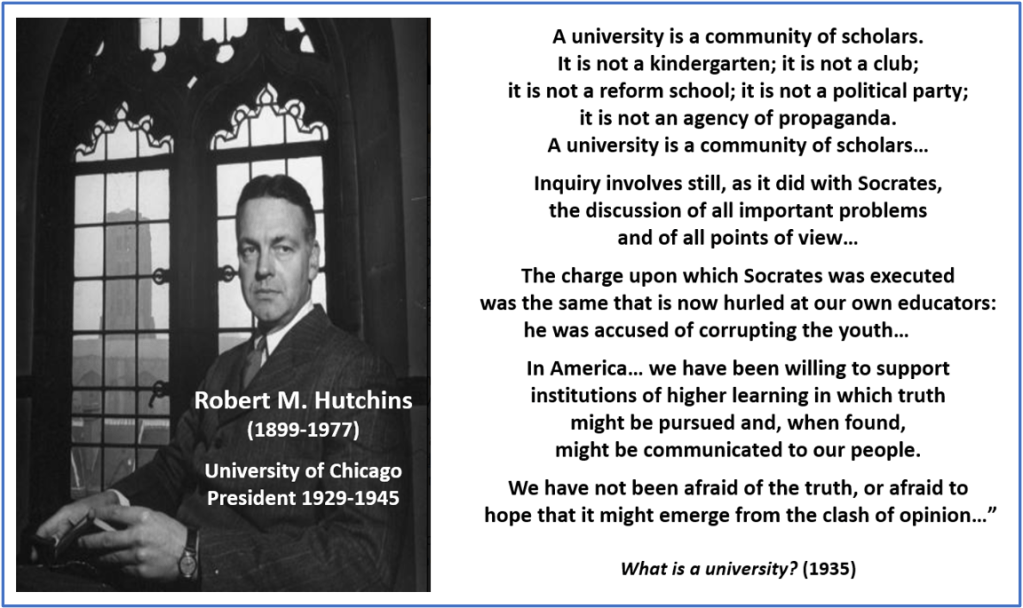
(As an aside, when the University of Chicago was accused of “fostering communism” in the 1930s, Hutchins defended the distinctive role of a university as a “community of scholars” in terms that will resonate with US university leaders and scholars today – see Chart 8). His address concluded: “The American people must decide whether they will longer tolerate the search for truth. If they will, the universities will endure and give light and leading to the nation. If they will not… we can blow out the light and fight it out in the dark; for when the voice of reason is silenced, the rattle of machine guns begins.”
Returning (again) to the Chart 1 sidebar quotes, Chart 9 draws from an 1859 work on the utility of free speech in public discourse and democratic deliberation, by English philosopher and politician John Stuart Mill. Here Mill suggests that often, both sides in a debate offer valid insights, and neither view is completely right. This reinforces the need for intellectual charity and humility noted earlier.
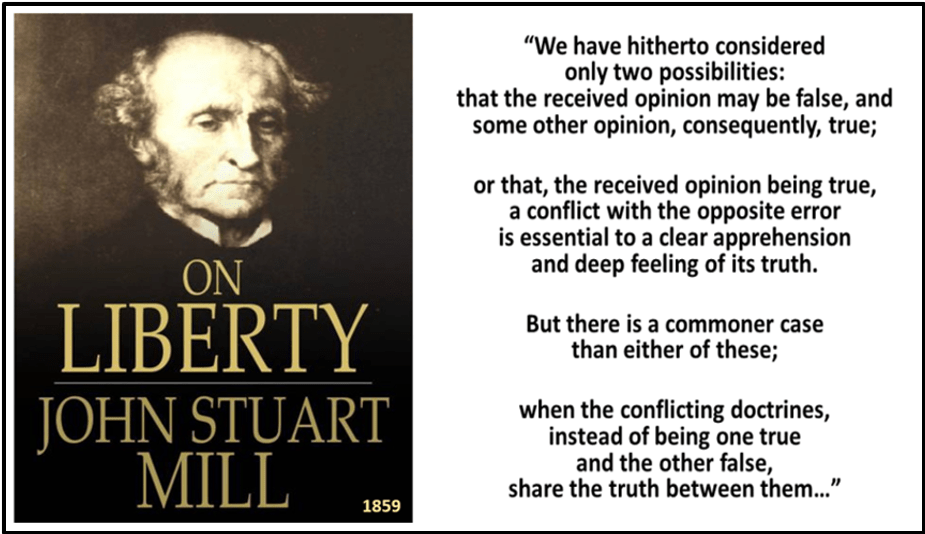
Chart 10 draws from a 1852 work on the distinct role of universities in promoting free inquiry and interchange across different branches of knowledge, by English philosopher John Henry Newman (an Oxford scholar who became Rector at the new Catholic University of Ireland, now University College Dublin). Today Newman might say that the university should be a “safe space” for minds to “collide and collaborate” where you can expect robust exchanges and critiques.
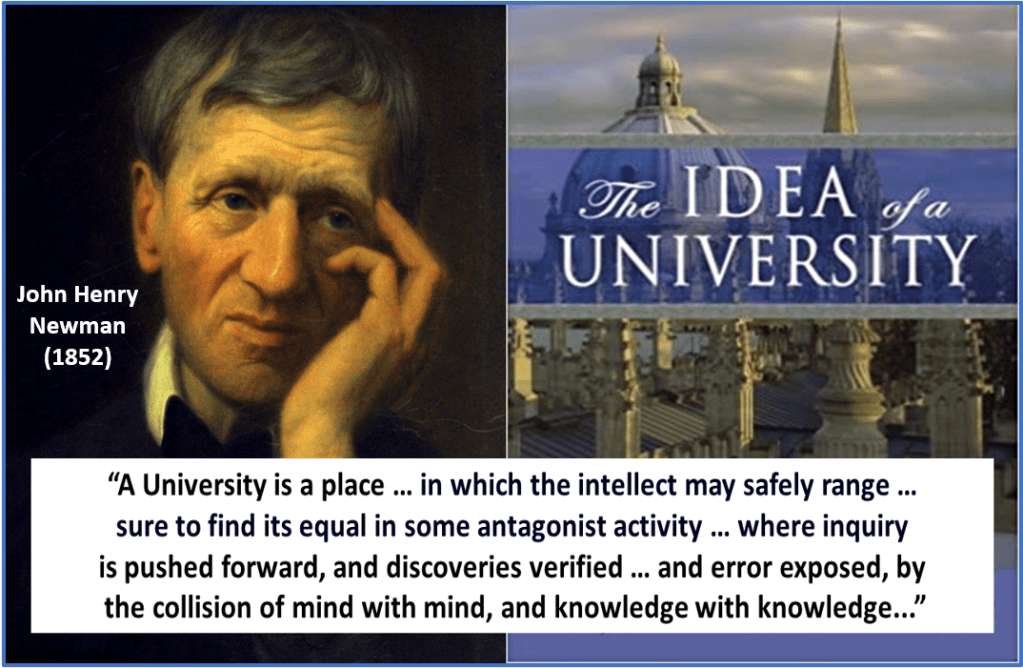
The definition of a critical thinking disposition Facione presents at Chart 5 is a plausible elaboration of what Newman meant by a “philosophical habit of mind”. (In Newman’s Idea of a University, “university training” must provide “the education which gives a man a clear conscious view of his own opinions and judgments, a truth in developing them, an eloquence in expressing them, and a force in urging them. It teaches him to see things as they are, to go right to the point, to disentangle a skein of thought, to detect what is sophistical, and to discard what is irrelevant…”)
Returning to the sidebar quotes, Chart 11 draws on an 1874 essay on the concept of Enlightenment by German philosopher Immanuel Kant. Here Kant promotes independent thinking, and free expression that may challenge prevailing orthodoxies, as a critical role for scholars.
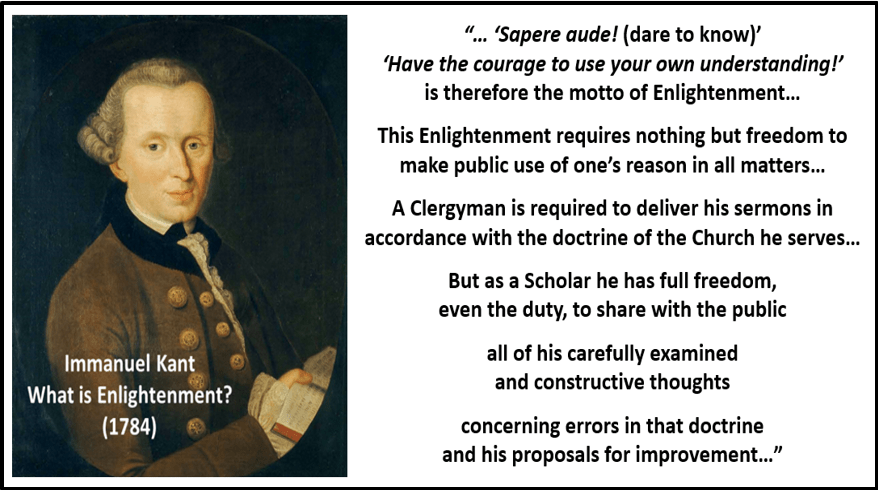
Chart 12 provides (in English) the original commentary (in Latin) by English philosopher Thomas Hobbes in 1642 (referred to earlier by Teresa Bejan). This reflects on why disagreements often make people feel attacked (and are often provoked into counter-attack). Both scholars highlight the practical value of civility to the maintenance of group cohesion and a tolerant society. As Bejan puts it in a later commentary in 2022:
“the conversational virtue of civility is salient to one kind of disagreement in particular ― namely, those in which the issues at stake are those we consider somehow “fundamental” to our worldviews, as well as to our personal and social identities…”
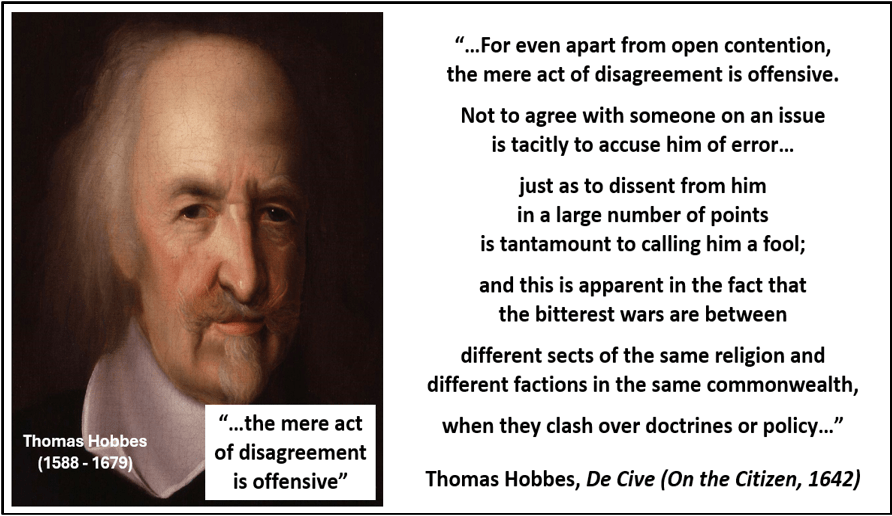
Chart 13 draws on a 1738 poem by French writer Voltaire, a proponent of free thinking, free speech, religious tolerance and human rights. His 1763 Treatise on Tolerance condemned fanaticism and the atrocities it led to in the religious wars of 18th-century Europe. His vision of the good society was one where individual freedom and community well-being were reciprocal human rights that compassionate citizens gave each other.
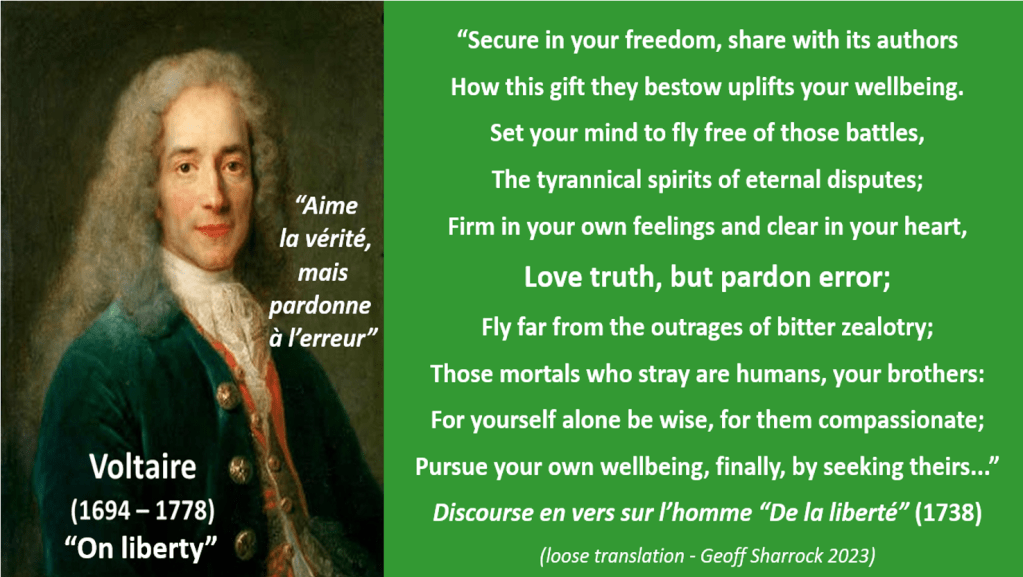
These messages from Voltaire and others will resonate for many students and scholars in Australian universities today, and in higher learning communities elsewhere.
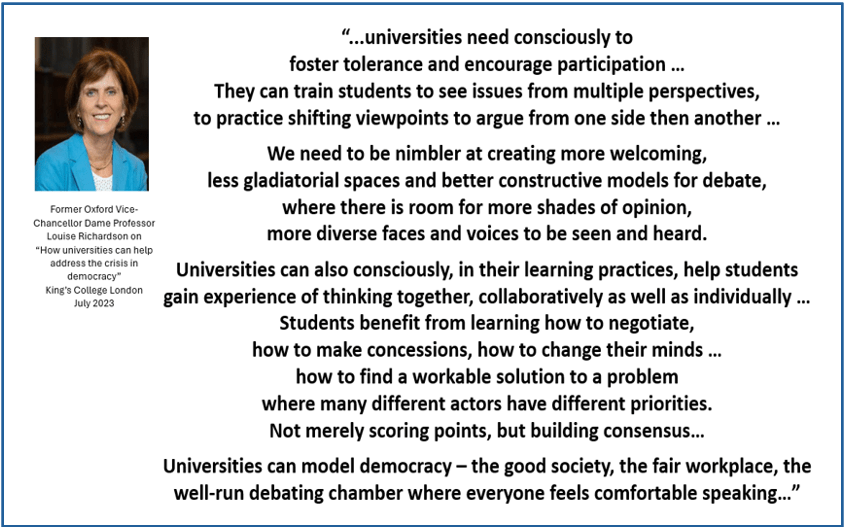
Multi-cultural societies rely heavily on tolerance when community views clash on what their laws or government priorities or social norms should be. As a former Oxford vice-chancellor argued in 2023, universities can help equip democracies to tackle these problems in ways that “foster tolerance” and support “the good society” – by enabling students to experience the practices and benefits of “constructive” debate and “collaborative” problem-solving (Chart 14).
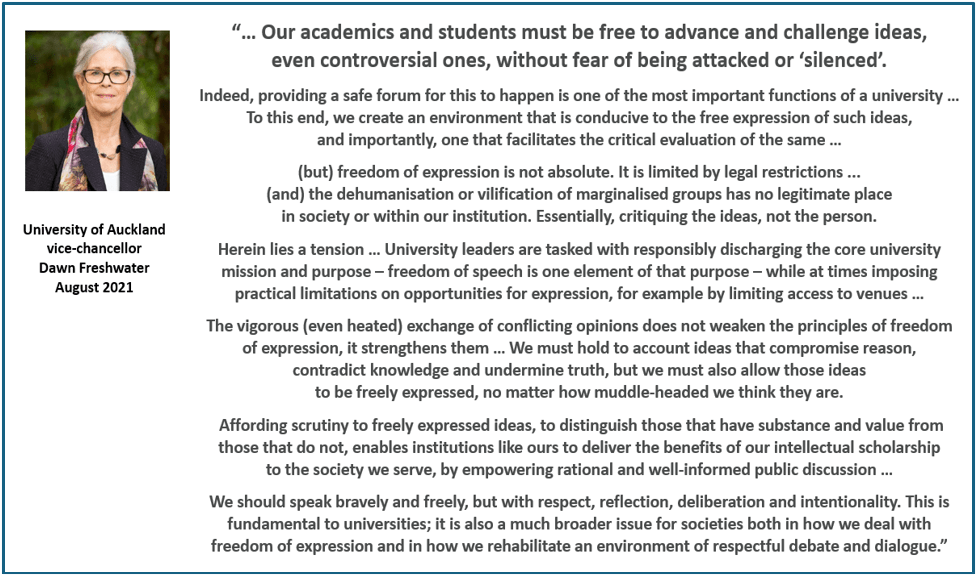
And in New Zealand in 2021, University of Auckland vice-chancellor Dawn Freshwater made a similar case in her media commentary (Chart 15).
In January this year, Western Sydney University chancellor Jennifer Westacott captured well what every Australian university seems to be aiming for, however its formal rules are framed: “We must be places of enlightenment, knowledge, social and economic progress, social cohesion, and tolerance, not places of division and hatred”.
Notes
Chart 16 provides a snapshot from the 2022 survey on campus expression in US higher education mentioned earlier, by Heterodox Academy. (I’ve seen no research that examines student views on free expression in Australia at this level of detail – but it’s fair to assume similar concerns among our students.)
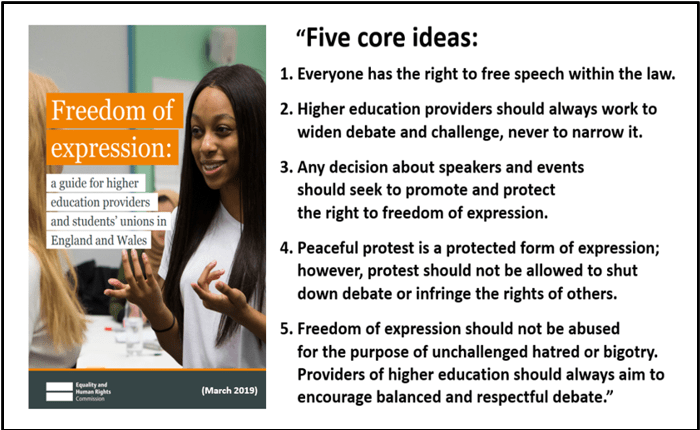
My “six habits” at Chart 1 align well with guidance in Australian universities, and higher education sector guidance in other liberal democracies. The UK’s Equality and Human Rights Commission, for example, offered similar guidance in 2019 (Chart 16). These “five core ideas” broadly reflect the approaches that Australian universities have taken to recent campus protests (which have generally been peaceful but in some cases have infringed the rights of others).
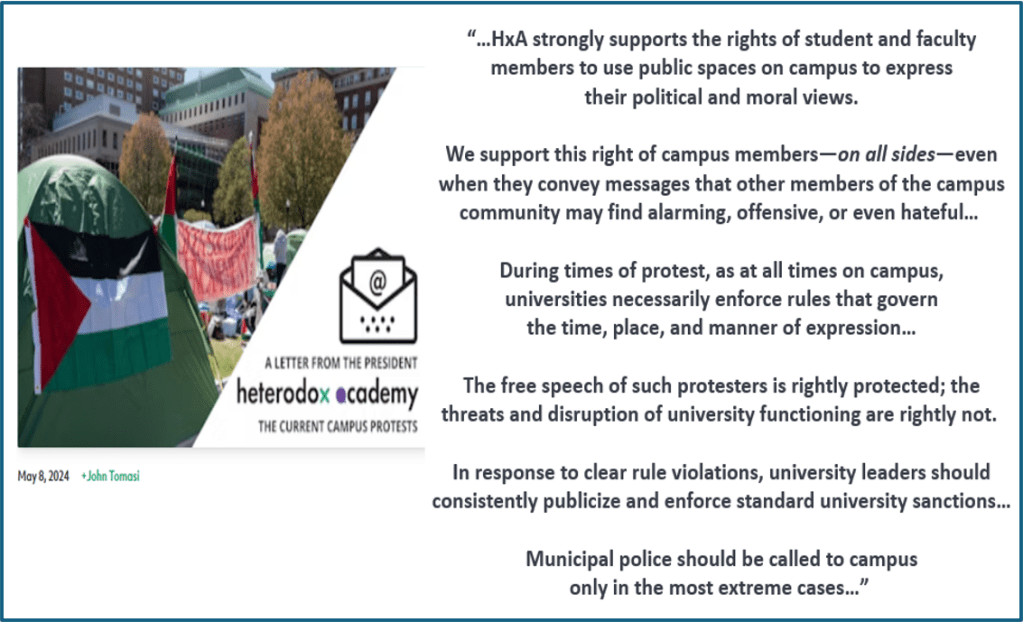
In the US last year, Heterodox Academy made similar points in its own guidance, as a response to campus protests (Chart 18). This echoes the well-known “Chicago Principles” Report of the Committee on Freedom of Expression, published in 2015 by the University of Chicago:
“…it is not the proper role of the University to attempt to shield individuals from ideas and opinions they find unwelcome, disagreeable, or even deeply offensive. Although the University greatly values civility, and although all members of the University community share in the responsibility for maintaining a climate of mutual respect, concerns about civility and mutual respect can never be used as a justification for closing off discussion of ideas, however offensive or disagreeable those ideas may be to some members of our community. The freedom to debate and discuss the merits of competing ideas does not, of course, mean that individuals may say whatever they wish, wherever they wish. The University may restrict expression that violates the law, that falsely defames a specific individual, that constitutes a genuine threat or harassment, that unjustifiably invades substantial privacy or confidentiality interests, or that is otherwise directly incompatible with the functioning of the University. In addition, the University may reasonably regulate the time, place, and manner of expression to ensure that it does not disrupt the ordinary activities of the University…”
As further background, Heterodox Academy’s earlier “HxA Way” guidance includes the following:
1. Make your case with evidence … Any specific statistics, quotes, or novel facts should have ready citations from credible sources.
2. Be intellectually charitable Viewpoint diversity is not incompatible with moral or intellectual rigor — in fact it actually enhances moral and intellectual agility. However, one should always try to engage with the strongest form of a position one disagrees with … Look for reasons why the beliefs others hold may be compelling, under the assumption that others are roughly as reasonable, informed, and intelligent as oneself.
3. Be intellectually humble Take seriously the prospect that you may be wrong. Be genuinely open to changing your mind about an issue…
4. Be constructive The objective of most intellectual exchanges should not be to “win,” but rather to have all parties come away from an encounter with a deeper understanding … Generally target ideas rather than people. Do not attribute negative motives to people you disagree with as an attempt at dismissing or discrediting their views…
5. Be yourself At Heterodox Academy, we believe that successfully changing unfortunate dynamics in any complex system or institution will require people to stand up — to leverage, and indeed stake, their social capital on holding the line, pushing back against adverse trends and leading by example…


2 thoughts on “Feel free to disagree on campus … as we all learn to “Enlighten Up””