The University as an “imagined community“
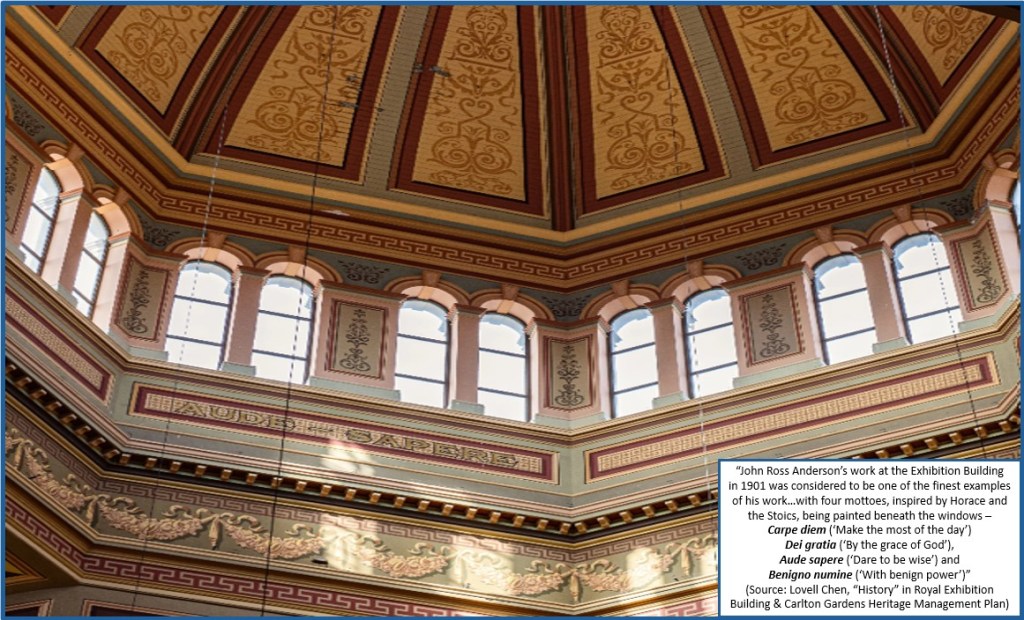
Gazing up at the dome in the Royal Exhibition Building during graduation, Melbourne Uni students may wonder what the words AUDE SAPERE mean. Any nearby professor (no doubt?) could tell them. And add that CARPE DIEM (like other Latin phrases seen on campus – POSTERA CRESCAM LAUDE, NON OMNIS MORIAR) also comes from the same ancient Roman poet (see Note 1).
The phrase “dare to know!” was recalled centuries later as a motto for Enlightenment (see Note 2). As well (our professor continues), it reflects a traditional idea of a university as an “imagined community” – where scholars seek, share and strengthen knowledge and understanding, by engaging in free inquiry and open disagreement.
To which a graduate might say: Sounds great in theory, professor! But how does that work in practice? In reply, our professor might refer to policies on their institution’s website about “freedom of speech”, “respectful discussion” and “diversity and inclusion”. Or suggest they read Open Minds – a 2021 book by two of the University’s law professors on academic freedom and free speech in Australia.
But when our graduate persists: Can you give us the gist? the professor might say: Well of course, it does get rather complicated…and as you know, we scholars aren’t always in the “gist business”. Perhaps you could start by Googling the French Review? Or its Model Code…? (see Note 3).
Phone in hand, the graduate soon finds the 2019 Review (a 300-page report: TL;DR). A key-word search finds it framing academic freedom as a defining characteristic of universities in the Western tradition: “The ideal of academic freedom can be traced back to Socrates’ defence in Plato’s Apology, before the Athenian people, of his right to discuss controversial topics with others…”
But, the Review notes, free expression isn’t an absolute right on campuses. As its Model Code makes clear, Australian laws and university regulations set limits. The Code is designed to protect other rights, and support institutional duties such as protecting student and staff “well-being”. In their discussion of the Review and the debates that swirled around it, the authors of Open Minds concur: “the reality is that freedom of speech is not truly absolute anywhere…In all systems of law and in all serious political thinking, freedom of speech has limits.”
As our professor says, it does get rather complicated.
What practices should campus policy promote? (Is this a “no-brainer“?)
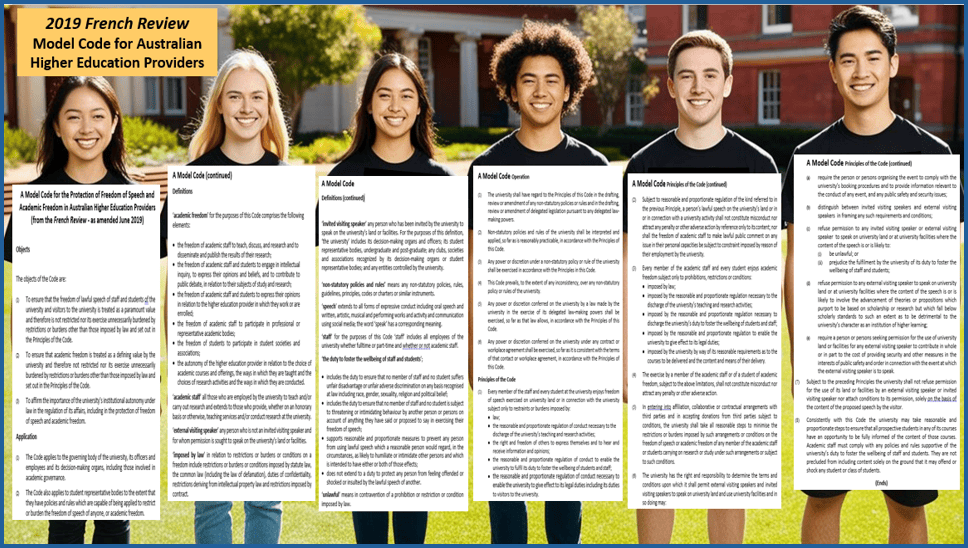
Since students can’t keep checking policies before they say anything, my Campus Culture Model Code sets out the gist of what Australian unis call for in their formal guidance and policy statements (Chart 1). The slogans here also reflect the detailed, legislation-oriented provisions of the French Review’s Model Code (at 1800 words, not T-shirt material); and well-known frameworks such as the Chicago Principles (see Notes 4, 5).
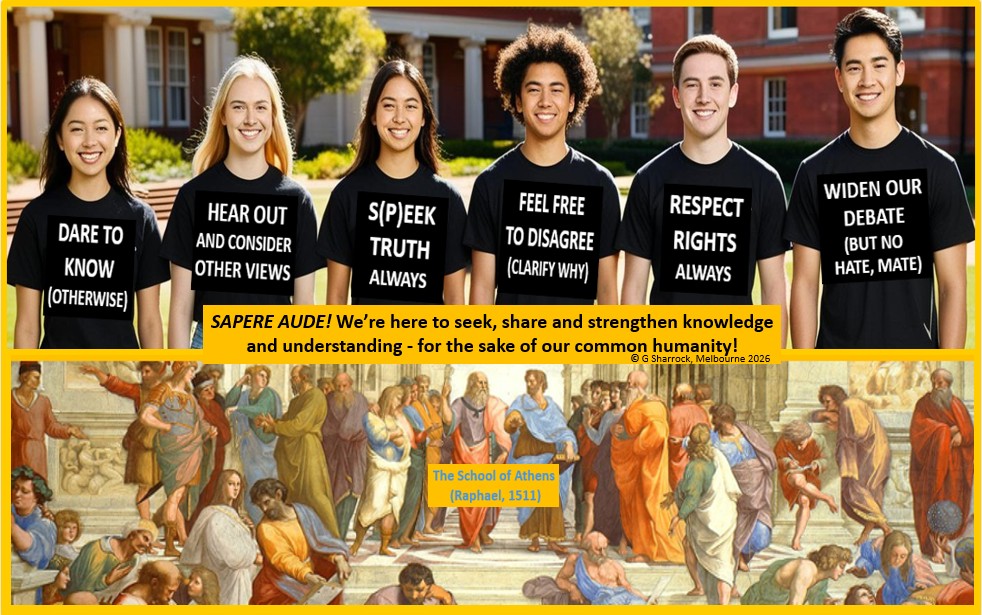
On Australian campuses, most students (I think) would accept these six simple statements as “fair enough” rules of engagement. They call for free expression, careful listening, intellectual honesty, critical thinking, constructive disagreement and respect for others’ lawful rights.
With different topics, audiences and forums, individuals would prioritise these items differently: outspoken or argumentative in some cases, sympathetic or reticent in others. But if accepted as “fair enough” overall, the list could be recalled readily – when polarising topics arise – to reinforce tolerance and civility as key elements of any campus community.
At the same time, nothing on the list requires students to pretend to respect any bullshit they encounter on campus. Just to recognise an opponent’s equal right to lawfully express their own (perhaps ignorant, immoral, unwise, simplistic, misguided, unenlightened, dogmatic, fallacious, incoherent, delusional, idiotic and/or offensive) views on the topic at hand (see Note 5).
Open societies rely heavily on “artificial virtues” such as tolerance and civility, as individuals self-regulate to protect themselves and others, and to promote community well-being. But societies are not well served if universities enforce campus “respect” rules to the point where clueless claims and senseless arguments routinely go unchallenged. Formal campus rules aside, there will always be peer pressure risks. These may amount to what (in his essay On Liberty) John Stuart Mill called “the tyranny of the prevailing opinion and feeling”. Since universities aim to equip students with critical thinking capabilities, not letting “the dogma eat your homework” should be a no-brainer on campuses. While highlighting the value of a culture of openness to the work of universities (see Note 5), the authors of Open Minds would not want students to be “so open-minded that their brains fall out”.
Chart 2 elaborates on the themes Chart 1 introduces, with a set of discursive norms or group learning habits. These echo what most universities say about the value of free inquiry, and the practice of robust and rational debate in this context. Scholars rely on norms like these to handle what John Henry Newman called the (inevitable) “collision of mind with mind, and knowledge with knowledge” in a university (see Note 7).
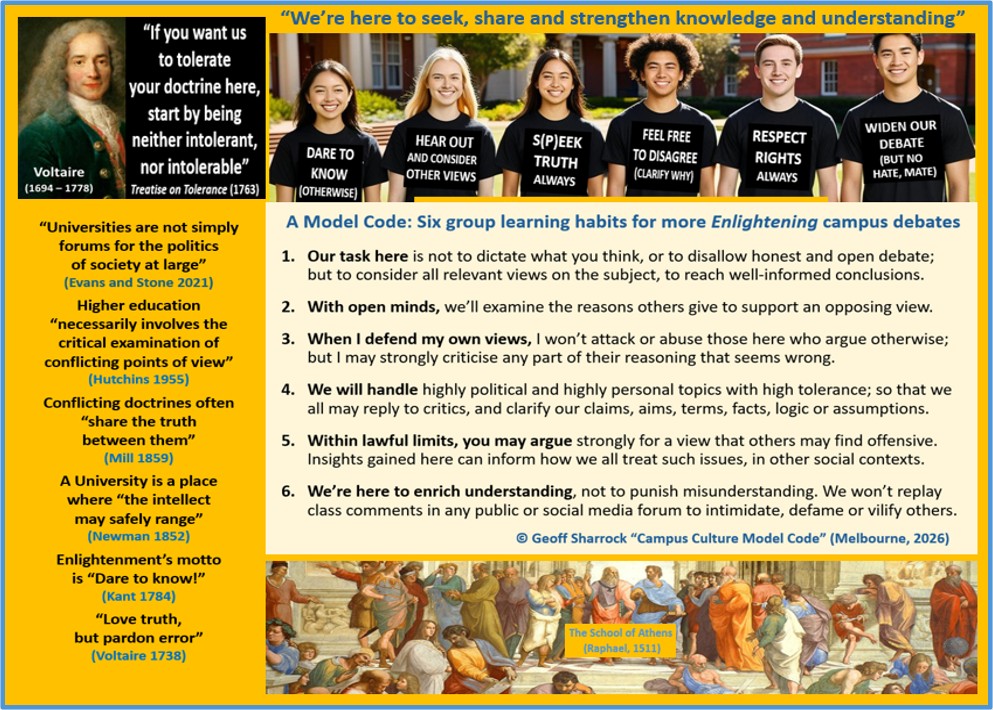
Of course – like the “good society” Socrates describes in Plato’s Republic – this “very model of a modern multiversity” (where everyone works in just this way) doesn’t really exist. It never has, except as a utopia (see Note 8). But for a university, promoting these ideals in this “imagined community” can help build its distinctive open campus culture, enlisting staff and students in the self-disciplined search for shared meaning, useful insights, better understandings, new discoveries and societal progress.
In this scenario, group forums would routinely widen viewpoint visibility. Individuals could feel equally free to disagree on any topic of study. Campus life could be radically inclusive. And on controversial topics, brave conversations could unfold to critically examine the full range of relevant facts, issues, options and viewpoints in safe discursive spaces.
Critical thinking, dialogue skills and “practical wisdom”
Taken together, these habits promote the art of dialogue to inform each group’s pursuit of truth, knowledge and understanding. As graduates, students with the skills and reflexes to “disagree well” would be better equipped to engage in deliberative practices and decision-making in other real-world contexts. These may be vital for more well-informed, wiser decisions to address complex real-world problems when different priorities, values, and interests intersect – what Aristotle called “practical wisdom”.
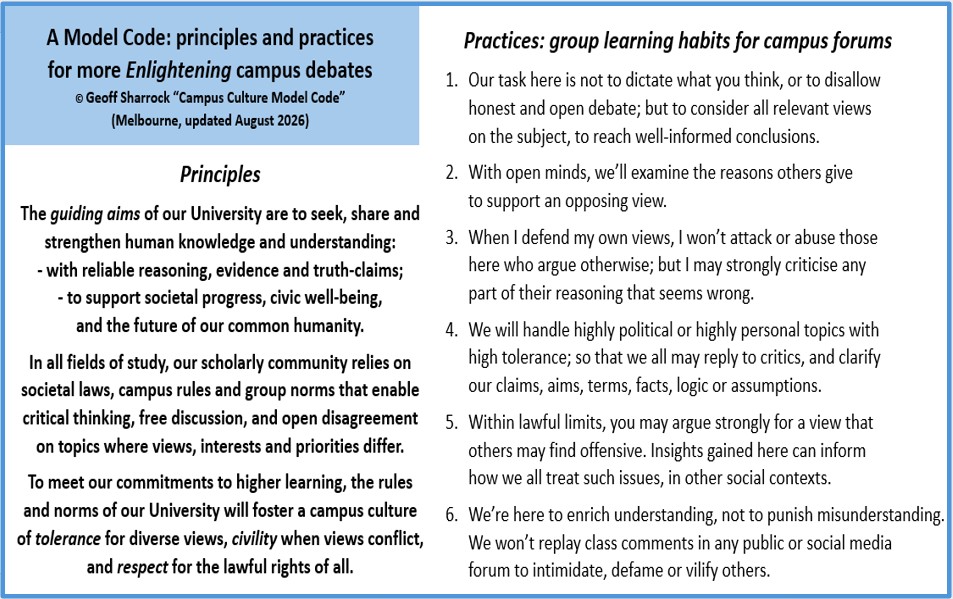
Chart 3 presents how broad institutional aims and principles are reflected in the same Chart 2 list of “model” practices. To the extent that access to expertise, their own efforts and their experience of study deliver all this, the “practical chemistry” that higher learning offers will serve the University’s guiding aims: to support societal progress, civic well-being, and the future of our common humanity.
Afterword
From the University’s institutional reputation perspective, there will always be cases where (as our professor notes) it’s complicated. Every so often, a scholar will say something controversial enough to provoke outrage – on campus and internally among colleagues, or in media reporting and social media commentary. If this leads to allegations of “unprofessional conduct”, managers may shift into damage control to assuage important stakeholders, or to protect the University’s reputation. As some Australian court cases illustrate, a University’s formal rules may not provide any easy answers to these claims and counterclaims.
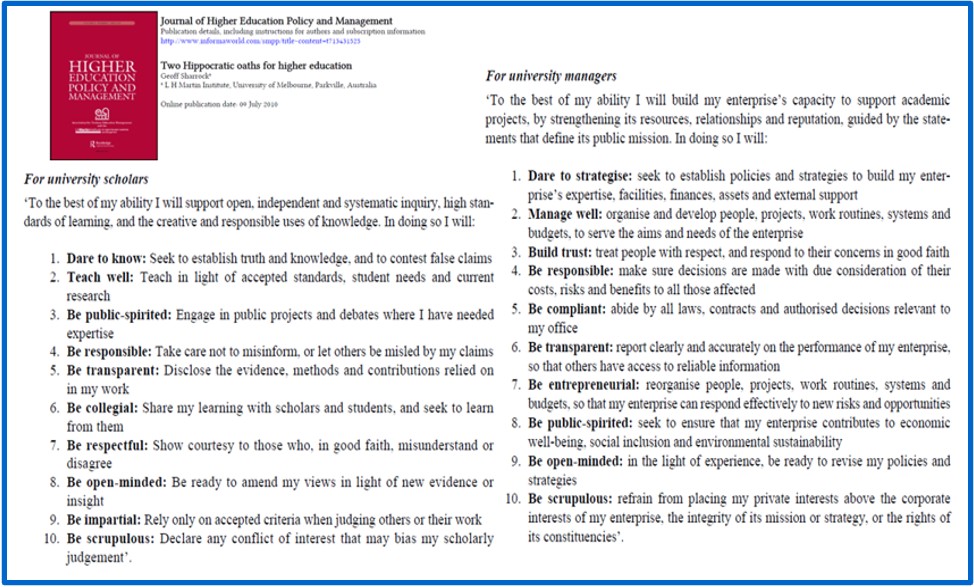
In the past, I’ve argued that different modes of professionalism result in different priorities. In the end, the modern “entrepreneurial” University is such a complex enterprise that scholars and managers often seem to be at cross-purposes, as each works to meet their professional commitments with integrity:
“…Typically, today’s universities rely on managerial professionalism far more than in the past, in tandem with scholarly professionalism. But these two modes of professionalism do not always mesh well. Each handles a different set of problems, so its practitioners require a different stance and outlook; and these problems are typically handled in a ‘black box’ where the logic behind a host of judgements and trade-offs is only rarely fully visible to outsiders. This situation gives rise to at least three common sources of dysfunction and distress in universities…”
Notes
1. In my Melbourne University graduation scenario, the professor’s response goes something like this:
“It means ‘dare to know’ or ‘dare to be wise’. As with the words CARPE DIEM up there – have you seen that old 1980s movie, Dead Poets Society? – it comes from an ode by Horace, the ancient Roman poet, writing around 20 BC. In another ode he coined our university’s motto, POSTERA CRESCAM LAUDE – another theme which one of our vice-chancellors took up a decade ago when writing about the University’s strategic plan. And in that same ode, Horace also wrote the phrase NON OMNIS MORIAR – which you’ll find in the 1888 Building, in the Gryphon Gallery’s memorial window. Actually, in his original epistle, Horace puts ‘dare to know’ the other way around: Sapere aude. And in 1784 the philosopher Immanuel Kant invokes ‘Sapere aude!’ as his “motto” for Enlightenment – a project that calls for citizens to think critically and draw their own conclusions. Of course, like Kant himself, you can still be wrong (his views on race were remarkably unenlightened)…”
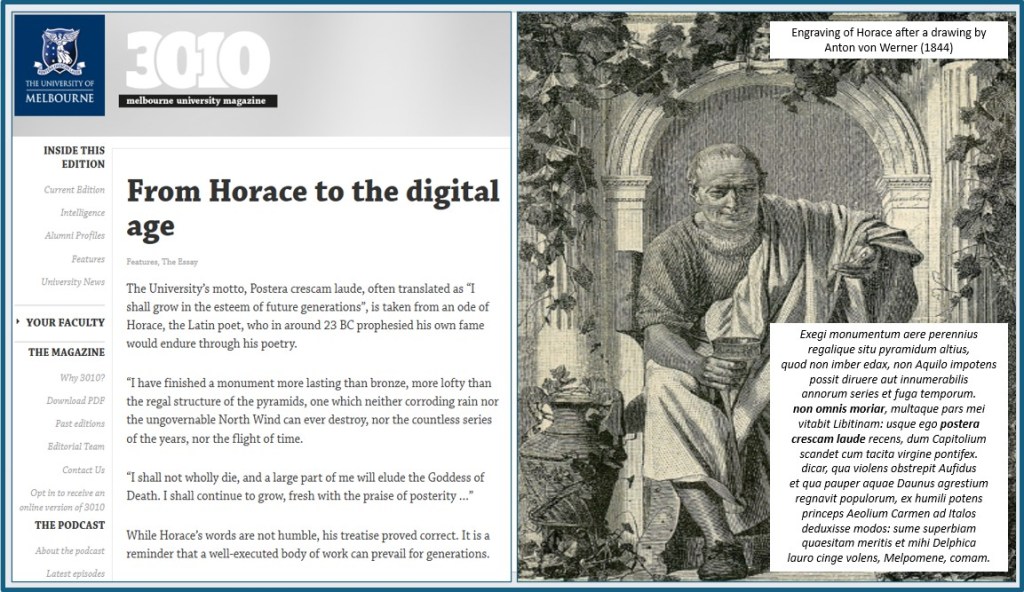
(Image and original Latin text added here)
Students searching the University of Melbourne’s website (as the professor suggests) will also find guidance such as Managing Polarising Topics in the Classroom. This recommends simple practices such as:
“Plucking up the courage to speak…Being clear and not too wishy-washy…Refraining from being overly dogmatic…Avoiding being unnecessarily offensive…”
2. For students interested in reading how Kant referenced Horace, Chart 6 shows an excerpt (as published in the Berlin Monthly in 1784):

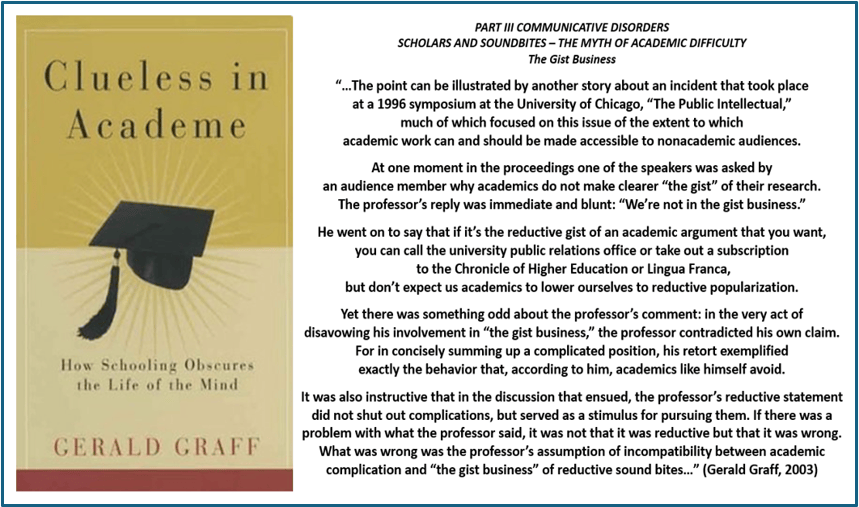
3. In Clueless in Academe, Gerald Graff examines the educational value of outlining “the gist” of a complex matter in simple terms.
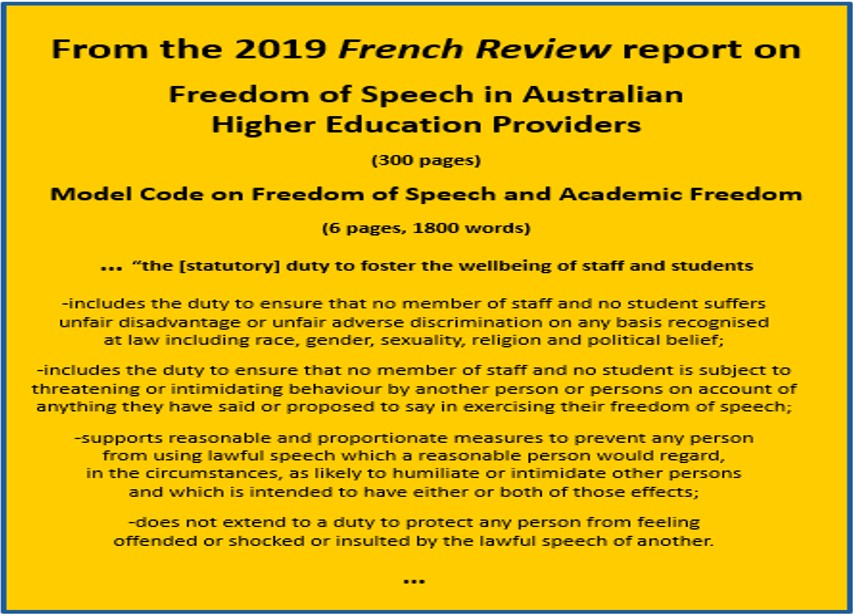
4. Charts 8 and 9 illustrate the difficulty of translating the French Review’s 1800-word Model Code into clear and simple guidance for students.
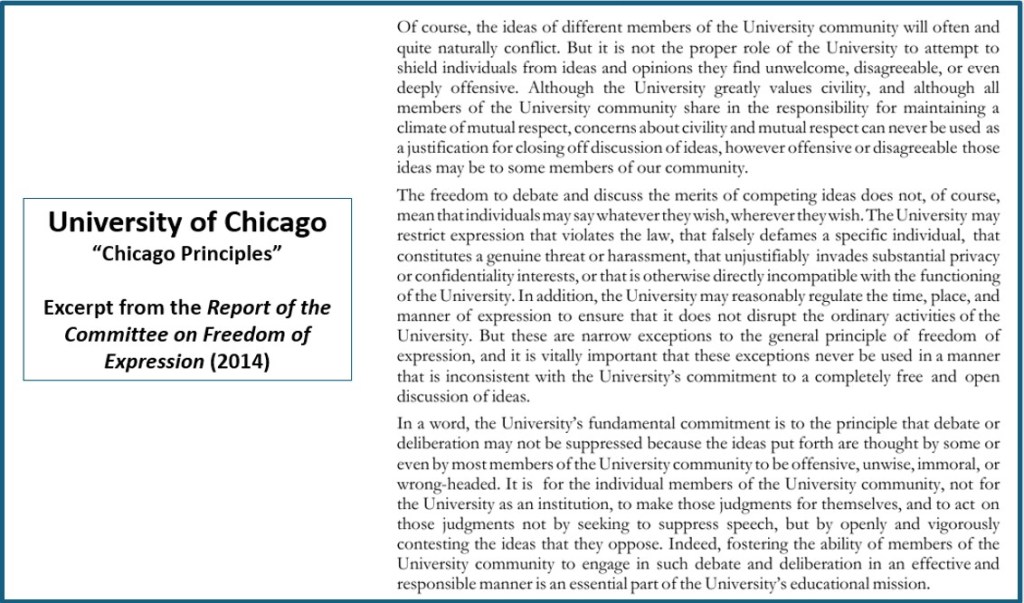
5. From. the University of Chicago 2014 report on free expression (Chart 10):
“Although the University greatly values civility, and although all members of the University community share in the responsibility for maintaining a climate of mutual respect, concerns about civility and mutual respect can never be used as a justification for closing off discussion of ideas…”
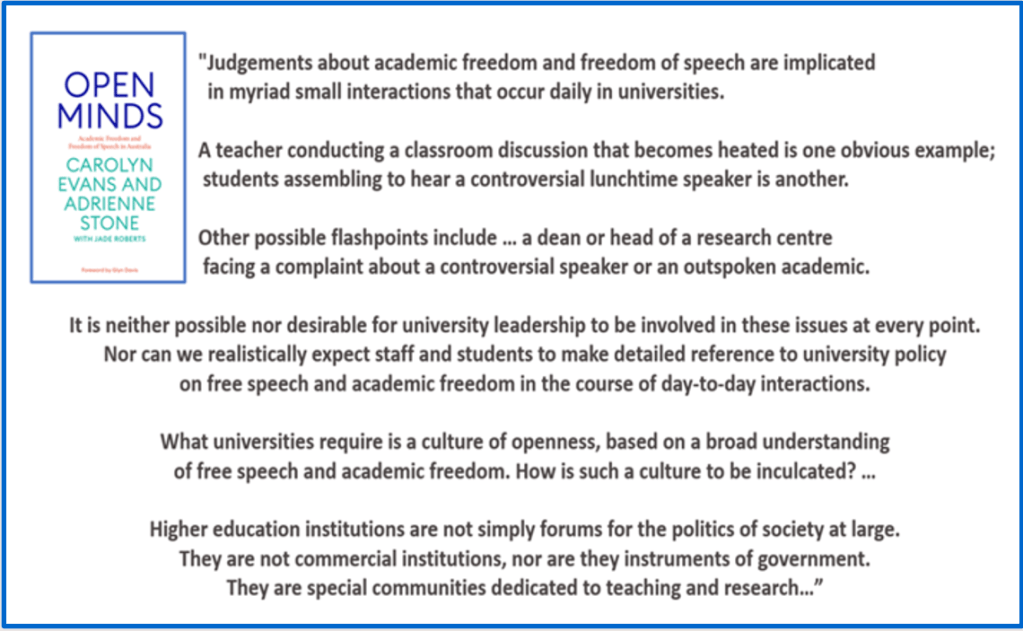
6. In Open Minds Evans and Stone argue for a “culture of openness, based on a broad understanding of free speech and academic freedom” (Chart 11).
7. John Henry Newman’s The Idea of a University (1852) describes the institution as:
“…a place to which a thousand schools make contributions; in which the intellect may safely range and speculate, sure to find its equal in some antagonist activity, and its judge in the tribunal of truth. It is a place where inquiry is pushed forward, and discoveries verified and perfected, and rashness rendered innocuous, and error exposed, by the collision of mind with mind, and knowledge with knowledge…”
8. In his essay “Varieties of Literary Utopias” (in Daedalus, 1965), Canadian literary critic Northrop Frye argues that the “just society” Socrates describes in Plato’s Republic:
“is not an actual society, but an informing power in the mind” designed to guide the conduct of educated citizens. As Book 9 of The Republic puts it (in an exchange between Socrates and Plato’s brother Glaucon):
Glaucon: “I understand; you speak of that city of which we are the founders, and which exists in idea only; for I do not think that there is such a one anywhere on earth.” Socrates: “In heaven, I replied, there is laid up a pattern of such a city, and he who desires may behold this, and beholding, govern himself accordingly. But whether there really is or ever will be such a one is of no importance to him; for he will act according to the laws of that city and of no other…”
Further reading
Glyn Davis (2010) The Republic of Learning (ABC Books)
Glyn Davis (2014) From Horace to the digital age (University of Melbourne website)
Department of Education (2019) Report of the Independent Review of Freedom of Speech in Australian Higher Education Providers (the French Review) (Commonwealth Department of Education)
Carolyn Evans and Adrienne Stone (2021) Open Minds: Academic Freedom and Freedom of Speech in Australia (La Trobe University Press)
Geoff Sharrock (2010) Two Hippocratic oaths for higher education (Journal of Higher Education Policy and Management)
Geoff Sharrock (2020) Feel free to disagree on campus…by learning to do it well (The Conversation)
Geoff Sharrock (2022) Free speech on campus calls for both hard heads and soft hearts (Times Higher Education)
Chris Ziguras (2024) Managing polarising topics in the classroom (Melbourne Centre for the Study of Higher Education website)
Heterodox Academy (2021) The HxA Way

