In the late 80s I lived in Fitzroy, drove a 1965 XP Falcon and worked in the Victorian public service. My main plan back then was to pay the hefty bank loan I’d signed up for to buy an old “two up, two down” terrace house in Napier Street.
A backstreet stroll from the cafes of Brunswick Street, my new place had all the mod cons: a grubby shag pile carpet in the front room, a walk-through kitchen that looked into an open-plan bathroom; and a tiny yard that backed onto a factory wall, with a dingy shed and a semi-reliable outdoor dunny.
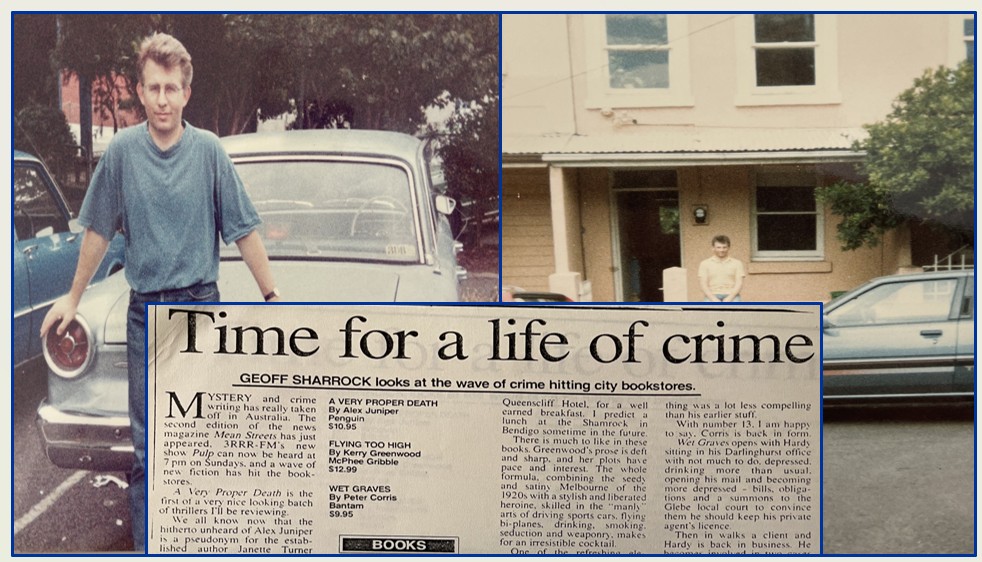
A former farm boy who’d moved to Melbourne to study Arts in the 70s, I was now a “job-ready” public servant, still keen on books and theatre from my student days.
I was living the (affordable) inner-city mean-streets dream. My weekday routine was to get up, put on a suit and walk to work in the city. In the evening I’d get a tram back to Fitzroy, dump my work gear, and head to Brunswick Street to wind down with a coffee and a book at Mario’s.
At the start of the 90s (economy in recession, interest rates high, and Victoria’s government shifting gear from the Cain-Kirner to the Kennett era), I started moonlighting as a freelance book reviewer.
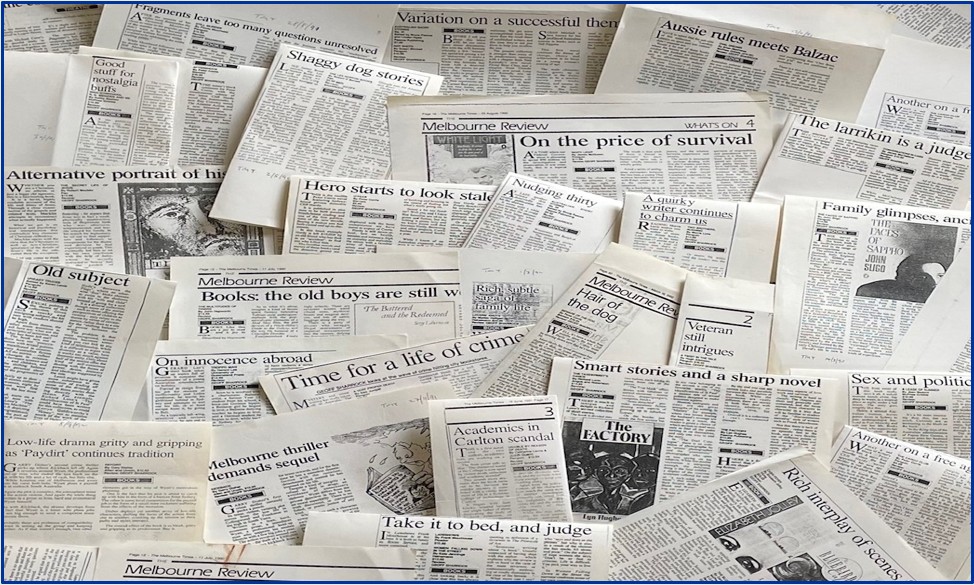
By 1993 I’d published 70-80 reviews of new Australian fiction, mainly in The Melbourne Times. Looking back, some more bluntly critical than I would be now.
For a hard-boiled fan of crime fiction, it was fun. I got to review established Australian writers like Peter Corris. And emerging ones like Kerry Greenwood, whose Phryne Fisher stories led to a wonderful ABC TV series two decades later.
Having failed last week to find any of those old TMT reviews online (never digitized it seems), I’ll just post some samples here (from the pile of faded photocopies I kept in a box back then). Full text further below.
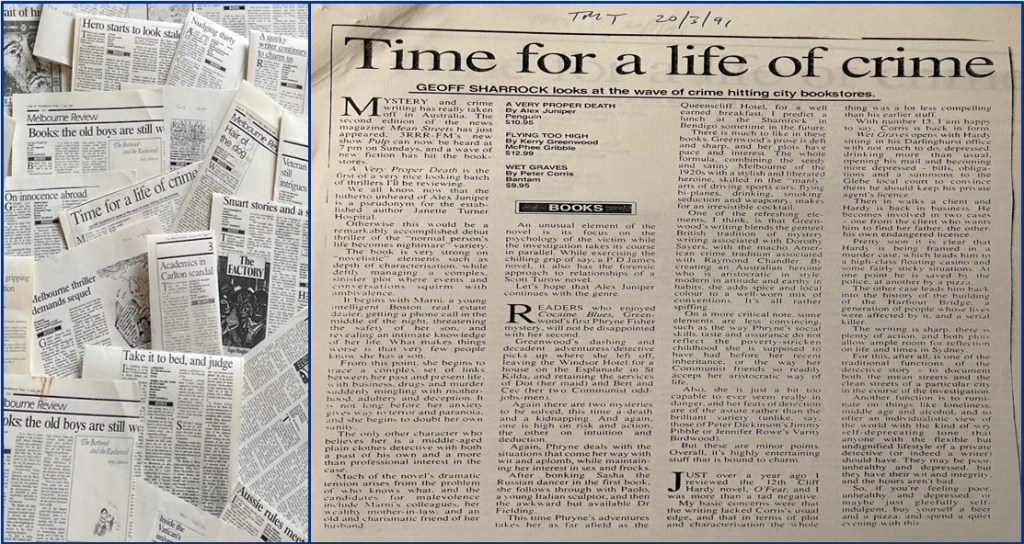
Published in The Melbourne Review, 20 March 1991
“Mystery and crime writing has really taken off in Australia. The second edition of the news magazine Mean Streets has just appeared. 3RRR-FM’s new show Pulp can now be heard at 7pm on Sundays, and a wave of new fiction has hit the bookstores.
A Very Proper Death is the first of a very nice-looking batch of thrillers I’ll be reviewing. We all know now that the hitherto unheard-of Alex Juniper is a pseudonym for the established author Janette Turner Hospital. Otherwise, this would be a remarkably accomplished debut thriller of the “normal person’s life becomes a nightmare” variety. The book is very strong on “novelistic” elements such as depth of characterization, while deftly managing a complex, sinister plot, where events and conversations squirm with ambivalence.
It begins with Marni, a young, intelligent Boston real estate dealer, getting a phone call in the middle of the night, threatening the safety of her son, and revealing an intimate knowledge of her life. What makes things worse is that very few people know she has a son. From this point she begins to trace a complex set of links between her past and present life, with business, drugs and murder suddenly mingling with motherhood, adultery and deception. It is not long before her anxiety gives way to terror and paranoia, and she begins to doubt her own sanity.
Much of the novel’s dramatic tension arises from the problem of who knows what, and the candidates for malevolence include Marni’s colleagues, her wealthy mother-in-law, and an old and charismatic friend of her husband. An unusual element of the novel is its focus on the psychology of the victim while the investigation takes its course in parallel. While exercising the chilling grip of say, a P D James novel, it also has the forensic approach to relationships of a Scott Turow novel. Let’s hope that Alex Juniper continues with the genre.”
“Readers who enjoyed Cocaine Blues, Greenwood’s first Phryne Fisher mystery, will not be disappointed with her second. Greenwood’s dashing and decadent adventuress/detective picks up where she left off, leaving the Windsor Hotel for a house on the Esplanade in St Kilda, and retaining the services of Dot (her maid) and Bert and Cec (her two communist odd-jobs-men). Again, there are two mysteries to be solved, this time a death and a kidnapping. And again, one is high on risk and action, the other on intuition and deduction.
Again, Phryne deals with the situations that come her way with wit and aplomb, while maintaining her interest in sex and frocks. After bonking Sasha and Russian dancer in the first book, Phryne follows through with Paolo, a young Italian sculptor, and then the awkward but available Dr Fielding. This time Phryne’s adventures take her as far afield as the Queenscliff Hotel, for a well-earned breakfast. I predict a lunch at the Shamrock in Bendigo sometime in the future.
There is much to like in these books. Greenwood’s prose is deft and sharp, and her plots have pace and interest. The whole formula, combining the seedy and the satiny Melbourne of the 1920s with a stylish and liberated heroine, skilled in the “manly” arts of driving sports cars, flying bi-planes, drinking, smoking, seduction and weaponry, makes for an irresistible cocktail. One of the refreshing elements, I think, is that Greenwood’s writing blends the genteel British tradition of mystery writing associated with Dorothy Sayers with the macho American crime tradition associated with Raymond Chandler. By creating an Australian heroine who is aristocratic in style, modern in attitude and earthy in habits, she adds spice to a well-worn mix of conventions. It’s all rather spiffing.
On a more critical note, some elements are less convincing, such as the way Phryne’s social skills, taste and assurance do not reflect the poverty-stricken childhood she is supposed to have had before her recent inheritance; or the way her communist friends so readily accept her aristocratic way of life. Also, she is just a bit too capable to ever seem really in danger, and her feats of detection are of the astute rather than the brilliant variety (unlike, say, those of Peter Dickinson’s Jimmy Pibble, or Jennifer Rowe’s Verity Birdwood).
But these are minor points. Overall, it’s highly entertaining stuff that is bound to charm.“
“Just over a year ago I reviewed the 12th Cliff Hardy novel, O’Fear, and I was more than a tad negative. My basic concerns were that the writing lacked Corris’s usual edge, and that in terms of plot and characterisation the whole thing was a lot less compelling than his earlier stuff. With number 13, I am happy to say, Corris is back in form. Wet Graves opens with Hardy sitting in his Darlinghurst office with not much to do, depressed, drinking more than usual, opening his mail and becoming more depressed – bills, obligations and a summons to the Glebe local court to convince them he should keep his private agent’s licence.
Then in walks a client and Hardy is back in business. He becomes involved in two cases – one from the client who wants him to find her father, the other, his own endangered licence. Pretty soon it is clear that Hardy is being framed in a murder case, which leads him to a high-class floating casino and some fairly sticky situations. At one point he is saved by the police, at another by a pizza. The other case leads him back into the history of the building of the Harbour Bridge, a generation of people whose lives were affected by it, and a serial killer.
The writing is sharp, there is plenty of action, and both plots allow ample room for reflection on life and times in Sydney. For this, after all, is one of the traditional functions of the detective story – to document both the mean streets and the clean streets of a particular city in the course of the investigation. Another function is to ruminate on things like loneliness, middle age and alcohol, and to offer an individualistic view of the world with the kind of wry, self-deprecating tone that anyone with the flexible but undignified lifestyle of a private detective (or indeed a writer) should have. They may be poor, unhealthy and depressed, but they have their wit and integrity, and the hours aren’t bad.
So, if you’re feeling poor, unhealthy and depressed, or maybe just gleefully self-indulgent, buy yourself a beer and a pizza, and spend a quiet evening with this.“


Somehow Geoffrey, none of this surprises me. What different souls we are, but i still treasure our school days friendship. Double or nothing !!